









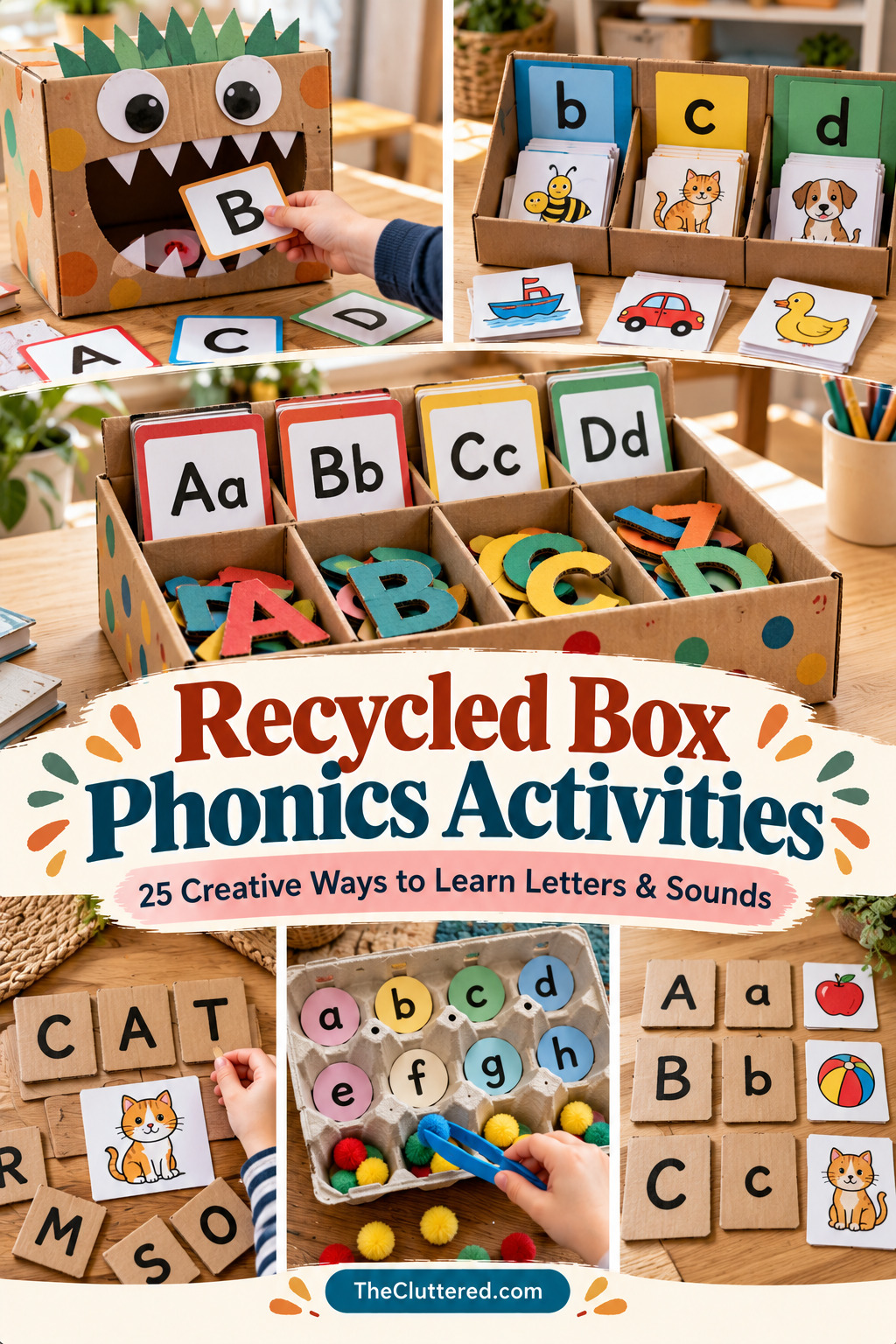


Recycled boxes can become surprisingly useful tools for early reading practice. With a clean cereal box, shoebox, egg carton, or a few cardboard scraps, you can make hands-on phonics activities that help children notice letters, connect letters with sounds, sort pictures, and build simple words.
The best part is that most of these games can be reset and reused. Start with one small learning goal, such as matching a letter or finding the first sound in a word, then change the cards as your child is ready for a new challenge.
Quick Start: Choose the Right Box Game
Try large letter matching, posting games, and simple sorting with just two or three choices.
Practice letter names, uppercase/lowercase matching, and beginning sounds with picture cards.
Build CVC words, sort by sound, and read short words using movable cardboard letters.
Make a shared sorting station or take-turns game with a clear prompt and a short round.
Why Use Recycled Boxes for Phonics?
Cardboard is easy to cut, label, and repurpose, so it works well for simple learning materials. A shallow box can hold letter tiles; a cereal box can become a posting game; and small compartments can help children sort cards by letter or sound. You can also replace a worn card without rebuilding the whole activity.
These projects do not need to look elaborate. Clear letters, sturdy pieces, and one understandable task are more important than decorations. If a child can quickly tell what to do, they can spend more time practicing and less time figuring out the rules.
Easy Recycled Box Phonics Activities to Try
1. Start with letter recognition
For early learners, use a small set of familiar letters instead of presenting the whole alphabet at once. Put a letter on each cardboard pocket or section, then ask the child to find a matching card. You can begin with uppercase letters and add lowercase matches later.
2. Connect letters with beginning sounds
Make a few picture cards with familiar objects—such as a sun, sock, map, or moon. Label cardboard pockets with the target letters. Say the picture word aloud and invite the child to listen for its first sound before placing it in a pocket. If the task feels difficult, model the sound slowly and offer only two choices.
3. Build short words with movable letters
Use cardboard tiles, large paper letters, or letter cards to build consonant-vowel-consonant (CVC) words such as cat, sun, and map. Say each sound, blend the sounds together, and read the word. Once a child can build a word, change one letter and compare the new word.
4. Make the box part of the game
A friendly monster, shark, mailbox, or treasure box can turn a short task into playful repetition. The character should support the learning goal rather than distract from it: find the requested letter, say its sound, then post or “feed” the card into the box.
5. Keep one activity adaptable
You do not need to make a new game for every skill. Keep the box and change the prompts. The same pockets can be used for letter matching one day, beginning sounds another day, and simple word sorting when the child is ready.
Materials to Gather
- Clean cereal boxes, shoeboxes, or sturdy shipping-box cardboard
- Large paper letter cards or cardboard letter tiles
- Markers, crayons, or printed letters
- Child-safe tape or glue used with adult help
- Picture cards showing familiar objects
- Scissors or a craft knife used by an adult only
- Optional: clean egg cartons or large bottle-cap substitutes
Choose materials that are clean, dry, and sturdy. Tape over sharp or rough edges, remove staples, and avoid small loose pieces with children who may put objects in their mouths. For toddlers, use oversized cardboard circles and letters instead of bottle caps or other small parts.
How to Make a Simple Cardboard Letter-Sorting Box
- Choose a base. A shallow box or the bottom half of a cereal box works well for a first version.
- Create two to four sections. Fold cardboard strips into dividers and secure them with tape.
- Label each section. Add large, clear letters or picture cues. Start with a small number of choices.
- Make matching cards. Cut sturdy cardboard into large cards and write one letter or draw one simple picture on each.
- Show how to play. Name the letter or say the picture word, model the sound if needed, then place the card in the matching section.
- Adjust the challenge. Add more letters, introduce lowercase matches, or sort pictures by beginning sound when the child is comfortable.
Keep the first version simple. If the box is hard to use, change the layout before adding more decorations. A useful learning tool is one that children can understand, handle, and reset with minimal frustration.
Ways to Adapt the Same Activity by Skill
| Learning focus | What to put on the box | Prompt to try |
|---|---|---|
| Letter names | Two or three large letters | “Can you find the letter M?” |
| Uppercase/lowercase | One uppercase model and lowercase cards | “Which lowercase letter matches this one?” |
| Beginning sounds | Letter-labeled pockets and picture cards | “What sound do you hear at the start of sun?” |
| Sound sorting | Two target-sound sections | “Does map start like moon or sun?” |
| CVC words | Three letter slots or a word strip | “Say each sound, then blend the word.” |
Keep the Game Enjoyable and Effective
- Keep each round short and stop before the child becomes tired or frustrated.
- Say sounds clearly and consistently; avoid adding an extra vowel sound to consonants when modeling.
- Use familiar words and pictures before introducing less familiar vocabulary.
- Offer a small number of choices when a child is learning a new skill.
- Let children take turns choosing a card, saying the sound, and placing it.
- Celebrate careful listening and trying again, not just correct answers.
- Store the cards in the same box so the activity is ready for another day.
For a classroom or homeschool setting, place the activity in a small-group literacy center and include a simple picture instruction card. Children can work through a familiar routine while an adult listens for the sounds or words they are practicing.
Quick Prep Checklist
- Choose one target skill: letters, sounds, or short words.
- Use a clean, sturdy box or piece of cardboard.
- Cover rough edges and remove staples.
- Make letters large and easy to distinguish.
- Begin with a small number of choices.
- Prepare picture cards with familiar words.
- Show the child one example before starting.
- Use short rounds with clear instructions.
- Change the prompt cards when the child is ready.
- Store all pieces together for easy reuse.
Frequently Asked Questions
What recycled boxes work best for phonics activities?
Cereal boxes, shoeboxes, and sturdy shipping boxes are useful because they can be cut into cards, trays, pockets, or game boards. Choose a size and thickness that is easy for the child to handle.
Which phonics activity should I try first?
Start with matching a few familiar letters. When that feels comfortable, move to uppercase/lowercase matching or picture sorting by beginning sound. Build short words only when the child is ready for that step.
Can I use these games in a classroom?
Yes. A box can hold the cards for a literacy center or small-group activity. Keep instructions brief, prepare enough cards for turns, and use a consistent place to store the pieces.
Are bottle caps and egg cartons safe for toddlers?
Small pieces can be choking hazards. For toddlers and children who mouth objects, use oversized cardboard pieces and supervise closely. Adults should prepare the materials and check for sharp or rough edges.
With a few recycled materials and a clear learning goal, you can create phonics games that are easy to refresh as children grow. Start with one box, one skill, and a handful of cards—then build out the activity when your young learner is ready for more.
25 Recycled Box Phonics Activities to Explore
Browse these visual examples for letter recognition, sound sorting, and early word-building inspiration. Each source image links to the available original page or pin; use the ideas as a starting point and adapt the materials to your child’s learning stage.
Bottle-Cap Letter Feeding Game

Source: Original source
Invite children to find a named letter or say its sound before placing the matching cap. Keep the set small at first, then add more letters as confidence grows.
This format can be adapted into a cardboard sorting tray: draw or tape one letter on each section and sort matching caps or paper circles.
To make this work for your learner, introduce one prompt at a time and let the child explain or say the answer before moving the card. Keep the materials large, simple, and easy to reset.
Cardboard Alphabet Box

Source: Original source
Small compartments make letters easier to handle and give children a clear visual place to return each match.
Reuse a sturdy box with dividers made from scrap cardboard. Label compartments with uppercase letters, lowercase letters, or picture cues.
To make this work for your learner, introduce one prompt at a time and let the child explain or say the answer before moving the card. Swap in new letters or picture prompts as the skill becomes familiar.
Cardboard Alphabet Learning Box

Source: Original source
Use one letter at a time to keep practice focused and allow children to repeat a match without needing a full worksheet.
Create a few labeled slots from folded cardboard and let children place letter cards or homemade letter tiles into the correct space.
To make this work for your learner, introduce one prompt at a time and let the child explain or say the answer before moving the card. Keep the materials large, simple, and easy to reset.
Hands-On Phonics Center

Source: Original source
A dedicated station makes it easy to rotate between matching, sorting, and sound practice while reusing the same materials.
Build a small center from a shallow box and swap the cards inside for the skill you are practicing that day.
To make this work for your learner, introduce one prompt at a time and let the child explain or say the answer before moving the card. Swap in new letters or picture prompts as the skill becomes familiar.
Monster Letter Eater

Source: Original source
Children can feed the character a requested letter, beginning sound, or sight word, depending on their current skill.
Decorate a small box as a friendly monster and cut a wide mouth opening. Use large cards rather than tiny pieces for younger children.
To make this work for your learner, introduce one prompt at a time and let the child explain or say the answer before moving the card. Keep the materials large, simple, and easy to reset.
Early Phonics Sound Practice

Source: Original source
Pairing spoken sounds with a physical choice gives children a clear action to complete after listening.
Add picture cards to a recycled-box sorting game. Say the target sound aloud and ask children to place a matching picture in the box.
To make this work for your learner, introduce one prompt at a time and let the child explain or say the answer before moving the card. Swap in new letters or picture prompts as the skill becomes familiar.
Initial-Sound Sorting

Source: Original source
Sorting encourages children to listen closely and compare words rather than guessing from letter shape alone.
Label small cardboard pockets with a few letters and sort picture cards such as sun, sock, moon, and map into the matching pockets.
To make this work for your learner, introduce one prompt at a time and let the child explain or say the answer before moving the card. Keep the materials large, simple, and easy to reset.
Cardboard Box Learning Activity

Source: Original source
A sturdy box can become a reusable surface for matching cards, placing letters, or organizing a short literacy game.
Use clean packaging cardboard, cover rough edges with tape, and keep the task simple enough to reset quickly.
To make this work for your learner, introduce one prompt at a time and let the child explain or say the answer before moving the card. Swap in new letters or picture prompts as the skill becomes familiar.
Letter-Sound Dice Game

Source: Original source
Rolling or selecting a prompt adds variety to short practice rounds and works well with an adult or a small group.
Make a large cube from scrap cardboard. Put a letter on each face, then say the sound, name a word, or find a matching picture.
To make this work for your learner, introduce one prompt at a time and let the child explain or say the answer before moving the card. Keep the materials large, simple, and easy to reset.
Spelling Box Activity

Source: Original source
Keeping letters in one place reduces setup time and makes it easier to repeat a short word-building challenge.
Use a shoebox as a tray for letter tiles. Start with two- or three-letter words and model how to say each sound before blending.
To make this work for your learner, introduce one prompt at a time and let the child explain or say the answer before moving the card. Swap in new letters or picture prompts as the skill becomes familiar.
DIY Phonics Activity

Source: Original source
The same base materials can support different levels when the prompt cards change from letter names to sounds or simple words.
Create a few cardboard prompt cards and pair them with letter tiles. Keep one target skill per round so children know what to listen for.
To make this work for your learner, introduce one prompt at a time and let the child explain or say the answer before moving the card. Keep the materials large, simple, and easy to reset.
Feed-the-Shark Initial Sounds

Source: Original source
Children listen to a word, identify its first sound, and choose the matching card to feed the character.
Turn a clean cereal box into a shark or fish. Add picture cards and label the collection pockets with target letters.
To make this work for your learner, introduce one prompt at a time and let the child explain or say the answer before moving the card. Swap in new letters or picture prompts as the skill becomes familiar.
Bottle-Top Letter Keyboard

Source: Original source
Loose letter pieces can be moved, grouped, and compared, making it easy to create many quick matching rounds.
Attach or place large, safe letter discs on a cardboard base. For children under three, avoid small caps and use oversized cardboard circles instead.
To make this work for your learner, introduce one prompt at a time and let the child explain or say the answer before moving the card. Keep the materials large, simple, and easy to reset.
Cardboard Spelling Game

Source: Original source
Word-building games make it possible to move letters around, try a new order, and read the result aloud.
Build a simple path or board from a flattened box and use removable letter tiles. Add a word card as the challenge for each turn.
To make this work for your learner, introduce one prompt at a time and let the child explain or say the answer before moving the card. Swap in new letters or picture prompts as the skill becomes familiar.
CVC Word Blocks

Source: Original source
CVC practice helps early readers connect individual letter sounds with a blended word, using familiar examples such as cat, sun, or map.
Make three cardboard tiles or small blocks for each word. Keep the middle vowel visible and swap one tile at a time to compare words.
To make this work for your learner, introduce one prompt at a time and let the child explain or say the answer before moving the card. Keep the materials large, simple, and easy to reset.
Recycled Alphabet Sorting

Source: Original source
Sorting letters into labeled spaces is easy to adjust for uppercase/lowercase matching or a small set of target letters.
Cut sturdy cardboard into large tiles and write one letter on each. Sort them into homemade pockets or shallow box compartments.
To make this work for your learner, introduce one prompt at a time and let the child explain or say the answer before moving the card. Swap in new letters or picture prompts as the skill becomes familiar.
CVC Word-Building Flower

Source: Original source
A repeatable layout helps children focus on changing one sound at a time and reading the finished word aloud.
Use a cardboard circle and petals as a reusable flower board. Put the middle sound or word family in the center and attach letter petals with removable tape.
To make this work for your learner, introduce one prompt at a time and let the child explain or say the answer before moving the card. Keep the materials large, simple, and easy to reset.
Egg-Carton Word Building

Source: Original source
Individual cups can keep letters in order and make it easier to build or change a short word one sound at a time.
Use a clean carton and large paper letters. Adults should trim rough edges and supervise use; substitute cardboard compartments if the carton is fragile.
To make this work for your learner, introduce one prompt at a time and let the child explain or say the answer before moving the card. Swap in new letters or picture prompts as the skill becomes familiar.
Monster Letter Sort

Source: Original source
A character gives children a clear goal: find the requested letter, check it, and place it in the right spot.
Make a friendly monster from a small box and create a few oversized letter cards. Ask children to feed only the letter you name.
To make this work for your learner, introduce one prompt at a time and let the child explain or say the answer before moving the card. Keep the materials large, simple, and easy to reset.
Cardboard Box Activity Ideas

Source: Original source
A box is flexible enough to become a tray, pocket holder, game board, or pretend-play prop without needing specialized supplies.
Choose one small literacy purpose first, then modify the box to fit that job instead of adding decoration that gets in the way.
To make this work for your learner, introduce one prompt at a time and let the child explain or say the answer before moving the card. Swap in new letters or picture prompts as the skill becomes familiar.
Reuse an Old Box for Learning

Source: Original source
A familiar container can hold the materials for quick review and make it simple to put the activity away after practice.
Add a pocket for sight-word cards or letter prompts. Invite the child to read a card before placing it into the matching section.
To make this work for your learner, introduce one prompt at a time and let the child explain or say the answer before moving the card. Keep the materials large, simple, and easy to reset.
Phonetic CVC Rods

Source: Original source
Sliding or rearranging letters helps children see that changing one sound can change the whole word.
Use strips of cardboard with three windows or slots. Slide letter cards through the strip to build simple words, then read each word aloud together.
To make this work for your learner, introduce one prompt at a time and let the child explain or say the answer before moving the card. Swap in new letters or picture prompts as the skill becomes familiar.
Feed-the-Monster Letter Game

Source: Original source
Children can search for a named letter, match a lowercase letter to an uppercase model, or identify the sound before feeding it.
Make a wide mouth opening in a box and decorate it with paper. Use large cards and keep the prompt clear: find, say, then feed.
To make this work for your learner, introduce one prompt at a time and let the child explain or say the answer before moving the card. Keep the materials large, simple, and easy to reset.
Letter Box Match

Source: Original source
A limited set of letters lets children practice matching without being overwhelmed by the full alphabet.
Make two sets of large letter cards from packaging cardboard. Put one set in the box and match each card to a letter mat or a second card.
To make this work for your learner, introduce one prompt at a time and let the child explain or say the answer before moving the card. Swap in new letters or picture prompts as the skill becomes familiar.
Recycled Cardboard Phonics Game

Source: Original source
Use this idea for a short practice round.
Adapt it with reusable cardboard pieces.
To make this work for your learner, introduce one prompt at a time and let the child explain or say the answer before moving the card. Keep the materials large, simple, and easy to reset.
Love these ideas? Follow @theclutteredblog on Pinterest for more cozy, practical gift inspiration!