









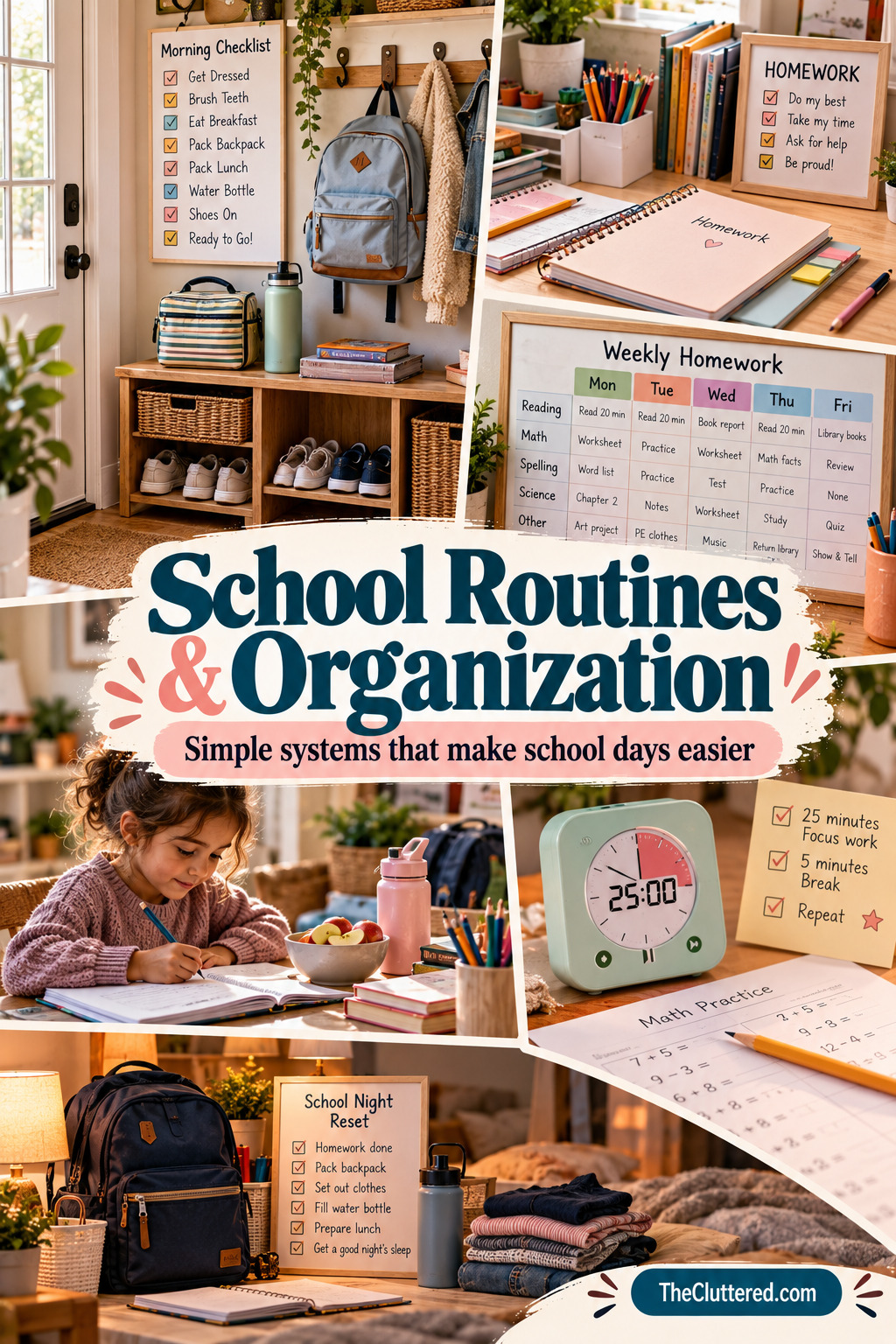


School days have a way of becoming complicated long before anyone sits down to do homework. Papers come home in backpacks, activities change from day to day, and a child who seemed completely fine at breakfast may suddenly be exhausted by 4 p.m. A workable system for school routines and organization does not need to make family life rigid. It simply gives everyone a few predictable places to look, a few repeatable steps to follow, and less to remember at the last minute.
The goal is not a picture-perfect schedule. It is a routine that fits your child, your household, and the realities of school nights. The ideas below focus on small systems parents can actually maintain: visual routines, homework planning, timers, reset habits, and shared family cues.
Start With the Parts of the Day That Keep Going Wrong
Before buying a planner or printing a routine chart, watch where the friction actually happens. Is the backpack always missing something? Does homework start too late? Are assignments forgotten because they are written in three different places? Does bedtime get pushed back because the evening has no clear stopping point?
Choose one or two pressure points first. A simple after-school sequence may solve more than a detailed hourly schedule. Likewise, a homework tracker can be more useful than a large family calendar if the real problem is knowing what is due next.
A Simple School-Day Rhythm
- Arrive home: Put the backpack, shoes, and lunch items in their assigned places.
- Reset: Give your child a short snack, water, movement, or quiet break.
- Check: Look at the homework list, school portal, or planner together when needed.
- Choose: Identify the first task rather than discussing the entire workload at once.
- Work: Use a reasonable focus period with a visible stopping point.
- Close: Pack finished work, reset supplies, and prepare anything needed for tomorrow.
This sequence can be shortened or expanded by age. Younger children may need more visual cues and parent support. Older children may only need the shared check-in and the expectation that they manage the details themselves.
Make Homework Easier to See
Many homework battles are really visibility problems. If a child has to remember an assignment, locate the materials, decide what to do first, estimate how long it will take, and remember tomorrow’s deadline all at once, the task can feel much bigger than it is.
Use one visible capture point. It could be a weekly homework sheet, a planner, a whiteboard, or a simple digital list. Keep the categories familiar: due today, due later, needs materials, finished. The point is to reduce mental juggling, not create another administrative job.
Use a Homework Station Without Overbuilding It
A homework station does not have to be a dedicated room. A small section of a kitchen table, a rolling cart, or one shelf can work if the supplies are predictable and easy to return.
- Keep the most-used pencils, paper, erasers, and chargers together.
- Give unfinished school papers one temporary home.
- Keep the work surface clear enough to start immediately.
- Store occasional supplies elsewhere so the daily area stays simple.
- Let your child help decide where frequently used items belong.
Organization works better when the child can complete the reset without needing an adult to put everything away.
Build a Routine Around Transitions, Not Just Times
A schedule that says “Homework at 4:00” can fail when the school bus is late, practice runs over, or your child needs a break. A transition-based routine is often more flexible: snack → reset → homework check → first task → break → finish → pack.
That sequence can move from 3:30 to 4:15 without making the whole system feel broken. This is especially helpful for families whose school and activity schedules change across the week.
When a Visual Timer Helps
A timer can make an abstract instruction such as “work for a while” more concrete. For some children, seeing a countdown makes the beginning and end of a work period easier to understand. The timer does not need to turn homework into a race; it can simply define a manageable block.
Try a short work period, followed by a planned break. If the assignment needs more time, reset the timer rather than treating the first block as a failure. For younger children, a visual countdown can also help with transitions such as getting dressed, packing a backpack, or moving from screen time to homework.
Protect Free Time and Sleep
A useful school routine includes stopping points. Children need time that is not organized around productivity, and schoolwork should not automatically expand to fill every available minute.
Look at the whole evening: homework, dinner, activities, family time, preparation for tomorrow, and bedtime. If the routine regularly pushes sleep too late, the answer may be to change the sequence, start earlier when practical, communicate with the school when appropriate, or reduce unnecessary evening complexity.
Make the System Age-Appropriate
| Age / Stage | Parent Support | Useful Organization Tool |
|---|---|---|
| Early elementary | Model the sequence and use simple visual cues. | Picture routine, short checklist, visual timer |
| Upper elementary | Help plan, then gradually hand over individual steps. | Homework tracker, weekly planner, supply station |
| Middle school | Shift toward check-ins rather than constant reminders. | Assignment planner, calendar, deadline list |
| High school | Support planning when needed while preserving ownership. | Weekly schedule, digital calendar, task system |
The goal of a family routine is not permanent parent management. Over time, the system should make it easier for children to recognize what needs to happen and take more responsibility for doing it.
A 10-Minute School-Night Reset
- Check tomorrow’s schedule.
- Finish or record unfinished homework.
- Put completed papers where they belong.
- Pack the backpack.
- Charge required devices.
- Set out anything needed for the morning.
- Check sports, activity, or appointment items.
- Return homework supplies to the station.
- Choose clothes if that helps the morning.
- Stop the school-planning conversation and transition into bedtime.
Ten minutes is only a starting point. The important part is that tomorrow gets a small amount of attention before everyone is tired and rushing.
School Routine Checklist for Parents
- Choose one place for homework information.
- Create a repeatable after-school sequence.
- Give backpacks a home near the entry.
- Keep everyday school supplies together.
- Use a visible homework tracker if assignments are being missed.
- Separate “due today” from “due later.”
- Break large assignments into smaller next actions.
- Use a timer when a clear work boundary helps.
- Schedule breaks intentionally.
- Protect a realistic bedtime.
- Review tomorrow before the evening ends.
- Let children participate in the organization system.
- Adjust routines for activity nights.
- Keep the system simple enough to maintain.
- Review what is not working instead of adding more rules.
FAQ
What is a good after-school routine for kids?
A useful routine usually has a predictable arrival, a short reset, a homework check, focused work, breaks, and a closing step such as packing the backpack. The exact timing should fit the child’s age and the family’s schedule.
Should parents sit with kids during homework?
It depends on the child and the assignment. Some children need help getting started or organizing materials, while others work better independently. A gradual shift from direct help to check-ins can support growing independence.
How can I stop homework from taking the entire evening?
Start by identifying whether the issue is workload, distractions, unclear instructions, difficulty beginning, or poor planning. A visible task list, defined work periods, planned breaks, and a consistent start cue can make the routine easier to manage.
Are visual timers useful for school routines?
They can be useful when a child benefits from seeing how long a transition or work period will last. Use the timer as a cue rather than a punishment, and adjust the length to the child’s needs.
How often should we change our school routine?
Change it when the family schedule, school demands, developmental needs, or recurring friction changes. A routine should be stable enough to become familiar but flexible enough to fit real life.
A good school routine is less about squeezing every minute into a schedule and more about making the next step obvious. Start with one recurring problem, create one simple system around it, and give your child a role in maintaining it. Once that piece works, add another only when it genuinely makes family life easier.
25-Image Pinterest Visual Listicle
Use these visual references as a curated gallery of practical school-routine and organization concepts. Each image supports a different angle of the parent-focused article.
Morning reset for School Routines & Organization

This visual focuses on a simple launch pad for calmer school mornings. The layout gives the routine a concrete place to live, whether that means a planner page, a checklist, a timer, or a clearly defined home for school tasks.
For parents, the useful part is the reduction of small decisions. Instead of repeatedly asking what comes next, the child can use a visible cue for morning routine organization. That makes the system easier to reference during a busy school day.
Adapt the idea to your home by changing the wording, colors, timing, or level of detail. Keep only the pieces your child actually needs, and place the finished system somewhere it can be used without a parent having to rebuild it every day.
Homework home base for School Routines & Organization

This visual focuses on a dedicated place for assignments and supplies. The layout gives the routine a concrete place to live, whether that means a planner page, a checklist, a timer, or a clearly defined home for school tasks.
For parents, the useful part is the reduction of small decisions. Instead of repeatedly asking what comes next, the child can use a visible cue for homework station organization. That makes the system easier to reference during a busy school day.
Adapt the idea to your home by changing the wording, colors, timing, or level of detail. Keep only the pieces your child actually needs, and place the finished system somewhere it can be used without a parent having to rebuild it every day.
Weekly homework map for School Routines & Organization

This visual focuses on a visual way to see the week before it gets busy. The layout gives the routine a concrete place to live, whether that means a planner page, a checklist, a timer, or a clearly defined home for school tasks.
For parents, the useful part is the reduction of small decisions. Instead of repeatedly asking what comes next, the child can use a visible cue for weekly homework planning. That makes the system easier to reference during a busy school day.
Adapt the idea to your home by changing the wording, colors, timing, or level of detail. Keep only the pieces your child actually needs, and place the finished system somewhere it can be used without a parent having to rebuild it every day.
Daily assignment tracker for School Routines & Organization

This visual focuses on a small tracker that makes unfinished work visible. The layout gives the routine a concrete place to live, whether that means a planner page, a checklist, a timer, or a clearly defined home for school tasks.
For parents, the useful part is the reduction of small decisions. Instead of repeatedly asking what comes next, the child can use a visible cue for homework tracking. That makes the system easier to reference during a busy school day.
Adapt the idea to your home by changing the wording, colors, timing, or level of detail. Keep only the pieces your child actually needs, and place the finished system somewhere it can be used without a parent having to rebuild it every day.
After-school rhythm for School Routines & Organization

This visual focuses on a predictable sequence from arriving home to starting homework. The layout gives the routine a concrete place to live, whether that means a planner page, a checklist, a timer, or a clearly defined home for school tasks.
For parents, the useful part is the reduction of small decisions. Instead of repeatedly asking what comes next, the child can use a visible cue for after-school routine. That makes the system easier to reference during a busy school day.
Adapt the idea to your home by changing the wording, colors, timing, or level of detail. Keep only the pieces your child actually needs, and place the finished system somewhere it can be used without a parent having to rebuild it every day.
School-time timetable for School Routines & Organization

This visual focuses on a flexible schedule that leaves room for real family life. The layout gives the routine a concrete place to live, whether that means a planner page, a checklist, a timer, or a clearly defined home for school tasks.
For parents, the useful part is the reduction of small decisions. Instead of repeatedly asking what comes next, the child can use a visible cue for school timetable. That makes the system easier to reference during a busy school day.
Adapt the idea to your home by changing the wording, colors, timing, or level of detail. Keep only the pieces your child actually needs, and place the finished system somewhere it can be used without a parent having to rebuild it every day.
Homework rules for School Routines & Organization

This visual focuses on simple household expectations that reduce repeated reminders. The layout gives the routine a concrete place to live, whether that means a planner page, a checklist, a timer, or a clearly defined home for school tasks.
For parents, the useful part is the reduction of small decisions. Instead of repeatedly asking what comes next, the child can use a visible cue for homework routine rules. That makes the system easier to reference during a busy school day.
Adapt the idea to your home by changing the wording, colors, timing, or level of detail. Keep only the pieces your child actually needs, and place the finished system somewhere it can be used without a parent having to rebuild it every day.
Kids routine chart for School Routines & Organization

This visual focuses on visual cues that help children move through routines. The layout gives the routine a concrete place to live, whether that means a planner page, a checklist, a timer, or a clearly defined home for school tasks.
For parents, the useful part is the reduction of small decisions. Instead of repeatedly asking what comes next, the child can use a visible cue for kids routine chart. That makes the system easier to reference during a busy school day.
Adapt the idea to your home by changing the wording, colors, timing, or level of detail. Keep only the pieces your child actually needs, and place the finished system somewhere it can be used without a parent having to rebuild it every day.
Homework planner for School Routines & Organization

This visual focuses on a clean planning page for deadlines and priorities. The layout gives the routine a concrete place to live, whether that means a planner page, a checklist, a timer, or a clearly defined home for school tasks.
For parents, the useful part is the reduction of small decisions. Instead of repeatedly asking what comes next, the child can use a visible cue for homework planner. That makes the system easier to reference during a busy school day.
Adapt the idea to your home by changing the wording, colors, timing, or level of detail. Keep only the pieces your child actually needs, and place the finished system somewhere it can be used without a parent having to rebuild it every day.
Study and homework log for School Routines & Organization

This visual focuses on a record that helps families notice what is piling up. The layout gives the routine a concrete place to live, whether that means a planner page, a checklist, a timer, or a clearly defined home for school tasks.
For parents, the useful part is the reduction of small decisions. Instead of repeatedly asking what comes next, the child can use a visible cue for study and homework log. That makes the system easier to reference during a busy school day.
Adapt the idea to your home by changing the wording, colors, timing, or level of detail. Keep only the pieces your child actually needs, and place the finished system somewhere it can be used without a parent having to rebuild it every day.
School night checklist for School Routines & Organization

This visual focuses on a short reset list for the evening before school. The layout gives the routine a concrete place to live, whether that means a planner page, a checklist, a timer, or a clearly defined home for school tasks.
For parents, the useful part is the reduction of small decisions. Instead of repeatedly asking what comes next, the child can use a visible cue for school night routine. That makes the system easier to reference during a busy school day.
Adapt the idea to your home by changing the wording, colors, timing, or level of detail. Keep only the pieces your child actually needs, and place the finished system somewhere it can be used without a parent having to rebuild it every day.
Visual timer for School Routines & Organization

This visual focuses on a concrete way to make work periods easier to understand. The layout gives the routine a concrete place to live, whether that means a planner page, a checklist, a timer, or a clearly defined home for school tasks.
For parents, the useful part is the reduction of small decisions. Instead of repeatedly asking what comes next, the child can use a visible cue for homework visual timer. That makes the system easier to reference during a busy school day.
Adapt the idea to your home by changing the wording, colors, timing, or level of detail. Keep only the pieces your child actually needs, and place the finished system somewhere it can be used without a parent having to rebuild it every day.
Five-minute start for School Routines & Organization

This visual focuses on a tiny starting ritual for children who resist getting started. The layout gives the routine a concrete place to live, whether that means a planner page, a checklist, a timer, or a clearly defined home for school tasks.
For parents, the useful part is the reduction of small decisions. Instead of repeatedly asking what comes next, the child can use a visible cue for homework start routine. That makes the system easier to reference during a busy school day.
Adapt the idea to your home by changing the wording, colors, timing, or level of detail. Keep only the pieces your child actually needs, and place the finished system somewhere it can be used without a parent having to rebuild it every day.
Focus sprint for School Routines & Organization

This visual focuses on short work blocks followed by intentional breaks. The layout gives the routine a concrete place to live, whether that means a planner page, a checklist, a timer, or a clearly defined home for school tasks.
For parents, the useful part is the reduction of small decisions. Instead of repeatedly asking what comes next, the child can use a visible cue for homework focus routine. That makes the system easier to reference during a busy school day.
Adapt the idea to your home by changing the wording, colors, timing, or level of detail. Keep only the pieces your child actually needs, and place the finished system somewhere it can be used without a parent having to rebuild it every day.
Homework reminder for School Routines & Organization

This visual focuses on a visible prompt that takes pressure off memory. The layout gives the routine a concrete place to live, whether that means a planner page, a checklist, a timer, or a clearly defined home for school tasks.
For parents, the useful part is the reduction of small decisions. Instead of repeatedly asking what comes next, the child can use a visible cue for homework reminder. That makes the system easier to reference during a busy school day.
Adapt the idea to your home by changing the wording, colors, timing, or level of detail. Keep only the pieces your child actually needs, and place the finished system somewhere it can be used without a parent having to rebuild it every day.
Balanced schedule for School Routines & Organization

This visual focuses on space for homework, sleep, activities, and free time. The layout gives the routine a concrete place to live, whether that means a planner page, a checklist, a timer, or a clearly defined home for school tasks.
For parents, the useful part is the reduction of small decisions. Instead of repeatedly asking what comes next, the child can use a visible cue for balanced school schedule. That makes the system easier to reference during a busy school day.
Adapt the idea to your home by changing the wording, colors, timing, or level of detail. Keep only the pieces your child actually needs, and place the finished system somewhere it can be used without a parent having to rebuild it every day.
Study time table for School Routines & Organization

This visual focuses on a flexible timetable that can adapt to different school days. The layout gives the routine a concrete place to live, whether that means a planner page, a checklist, a timer, or a clearly defined home for school tasks.
For parents, the useful part is the reduction of small decisions. Instead of repeatedly asking what comes next, the child can use a visible cue for study timetable. That makes the system easier to reference during a busy school day.
Adapt the idea to your home by changing the wording, colors, timing, or level of detail. Keep only the pieces your child actually needs, and place the finished system somewhere it can be used without a parent having to rebuild it every day.
Assignment checklist for School Routines & Organization

This visual focuses on a simple checklist for breaking work into next actions. The layout gives the routine a concrete place to live, whether that means a planner page, a checklist, a timer, or a clearly defined home for school tasks.
For parents, the useful part is the reduction of small decisions. Instead of repeatedly asking what comes next, the child can use a visible cue for homework checklist. That makes the system easier to reference during a busy school day.
Adapt the idea to your home by changing the wording, colors, timing, or level of detail. Keep only the pieces your child actually needs, and place the finished system somewhere it can be used without a parent having to rebuild it every day.
School planner page for School Routines & Organization

This visual focuses on one place to capture classes, tasks, and deadlines. The layout gives the routine a concrete place to live, whether that means a planner page, a checklist, a timer, or a clearly defined home for school tasks.
For parents, the useful part is the reduction of small decisions. Instead of repeatedly asking what comes next, the child can use a visible cue for school planner. That makes the system easier to reference during a busy school day.
Adapt the idea to your home by changing the wording, colors, timing, or level of detail. Keep only the pieces your child actually needs, and place the finished system somewhere it can be used without a parent having to rebuild it every day.
Homework tracker printable for School Routines & Organization

This visual focuses on a quick visual reference for the week. The layout gives the routine a concrete place to live, whether that means a planner page, a checklist, a timer, or a clearly defined home for school tasks.
For parents, the useful part is the reduction of small decisions. Instead of repeatedly asking what comes next, the child can use a visible cue for homework tracker. That makes the system easier to reference during a busy school day.
Adapt the idea to your home by changing the wording, colors, timing, or level of detail. Keep only the pieces your child actually needs, and place the finished system somewhere it can be used without a parent having to rebuild it every day.
Routine timer for School Routines & Organization

This visual focuses on a timer-based cue for transitions between activities. The layout gives the routine a concrete place to live, whether that means a planner page, a checklist, a timer, or a clearly defined home for school tasks.
For parents, the useful part is the reduction of small decisions. Instead of repeatedly asking what comes next, the child can use a visible cue for kids routine timer. That makes the system easier to reference during a busy school day.
Adapt the idea to your home by changing the wording, colors, timing, or level of detail. Keep only the pieces your child actually needs, and place the finished system somewhere it can be used without a parent having to rebuild it every day.
Learning support board for School Routines & Organization

This visual focuses on a calm visual system for children who need extra structure. The layout gives the routine a concrete place to live, whether that means a planner page, a checklist, a timer, or a clearly defined home for school tasks.
For parents, the useful part is the reduction of small decisions. Instead of repeatedly asking what comes next, the child can use a visible cue for learning support routine. That makes the system easier to reference during a busy school day.
Adapt the idea to your home by changing the wording, colors, timing, or level of detail. Keep only the pieces your child actually needs, and place the finished system somewhere it can be used without a parent having to rebuild it every day.
Chore-to-homework transition for School Routines & Organization

This visual focuses on a clear bridge between responsibilities and schoolwork. The layout gives the routine a concrete place to live, whether that means a planner page, a checklist, a timer, or a clearly defined home for school tasks.
For parents, the useful part is the reduction of small decisions. Instead of repeatedly asking what comes next, the child can use a visible cue for after-school transition. That makes the system easier to reference during a busy school day.
Adapt the idea to your home by changing the wording, colors, timing, or level of detail. Keep only the pieces your child actually needs, and place the finished system somewhere it can be used without a parent having to rebuild it every day.
Family command center for School Routines & Organization

This visual focuses on a shared view of school tasks and household plans. The layout gives the routine a concrete place to live, whether that means a planner page, a checklist, a timer, or a clearly defined home for school tasks.
For parents, the useful part is the reduction of small decisions. Instead of repeatedly asking what comes next, the child can use a visible cue for family school organization. That makes the system easier to reference during a busy school day.
Adapt the idea to your home by changing the wording, colors, timing, or level of detail. Keep only the pieces your child actually needs, and place the finished system somewhere it can be used without a parent having to rebuild it every day.
End-of-day reset for School Routines & Organization

This visual focuses on a five-minute reset that prepares tomorrow before bedtime. The layout gives the routine a concrete place to live, whether that means a planner page, a checklist, a timer, or a clearly defined home for school tasks.
For parents, the useful part is the reduction of small decisions. Instead of repeatedly asking what comes next, the child can use a visible cue for school night reset. That makes the system easier to reference during a busy school day.
Adapt the idea to your home by changing the wording, colors, timing, or level of detail. Keep only the pieces your child actually needs, and place the finished system somewhere it can be used without a parent having to rebuild it every day.
Love these ideas? Follow @theclutteredblog on Pinterest for more cozy, practical gift inspiration!