









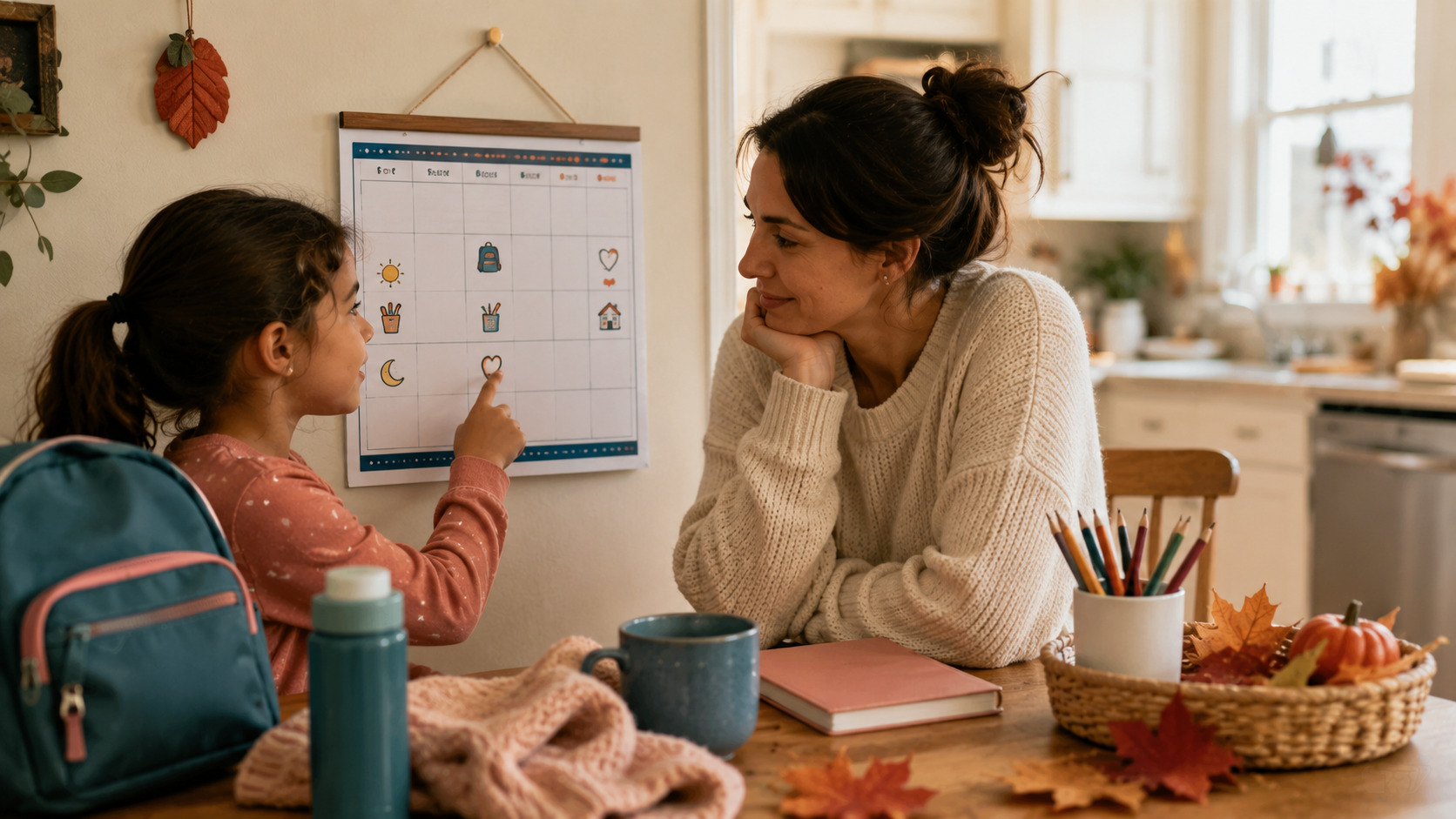
Does your child become clingy, emotional, or resistant whenever summer routines begin to change? The move from relaxed days to earlier bedtimes, school preparation, new activities, and cooler evenings can feel like a lot for the whole family. Gentle parenting through fall transitions gives children structure without rushing their emotions, helping them move from one season to the next with connection, predictability, and steady support.


A calm seasonal transition does not mean every morning will be smooth. It means children are given time to understand what is changing, space to express mixed feelings, and small opportunities to practice new routines. With a visual schedule for kids, a family wall calendar, and a children’s feelings chart, parents can make fall changes easier to see and talk about. This guide explains how to help kids transition from summer to fall gently, support school anxiety, adjust sleep gradually, and create a fall routine that feels supportive rather than overwhelming.

Why seasonal transitions feel difficult
Children often experience several changes at once during the transition from summer to fall. Bedtime may become earlier, school or daycare may begin, caregivers may change, extracurricular activities may return, and free time may become more limited. Even positive changes can feel stressful when they happen quickly.
A child may show stress through whining, meltdowns, clinginess, sleep resistance, irritability, or suddenly needing more help with tasks they previously handled alone. These behaviors do not automatically mean a child is being defiant. They may be communicating that the new routine feels unfamiliar or demanding.
Gentle parenting seasonal transitions starts with recognizing that adjustment takes time. Familiar routines, honest conversations, and emotional validation can help children feel more grounded while the schedule changes.hope-health+1
Instead of asking, “Why are you making this so difficult?” try asking:
- “Which part of tomorrow feels hard?”
- “Would you like help getting started?”
- “Do you want to know what will happen next?”
- “Are you feeling worried, tired, or disappointed?”
- “Would you like a hug, quiet time, or a choice?”
These questions do not remove every limit. They help you hold the limit while staying connected to the child experiencing it.
Prepare children before the routine changes
How to prepare children emotionally for fall changes begins with simple, repeated conversations. Avoid explaining everything once and expecting your child to remember it. Mention the change naturally while driving, eating, walking, or getting ready for bed.
For younger children, use clear and concrete language:
“Summer is changing. Soon, we will wake up earlier, eat breakfast, and go to preschool. You will have time to play after we come home.”
For older children, include more details about schedules, transportation, homework, activities, and downtime. Children often feel calmer when they know what will happen and which parts of the day will remain familiar.
A children’s visual calendar can show the days remaining before school begins or help explain a new weekly rhythm. Keep it simple enough for your child to understand. Use pictures, colors, or removable markers instead of filling every space with too many details.
You can also visit the school, walk past the building, practice the route, or look at photos of the classroom. These small previews make the unfamiliar feel more manageable. If your child feels nervous, you do not need to insist that they feel excited. You can say, “You can feel nervous and still learn what will happen next.”
Build a gentle fall routine gradually
A gentle parenting school routine should provide structure without demanding instant perfection. Begin with the parts of the schedule that matter most, such as wake-up time, meals, bedtime, and the morning departure.
Many families find it easier to adjust bedtime and wake-up times in small increments rather than changing them all at once. Move bedtime earlier by 15–20 minutes every few nights, then gradually shift the morning wake-up time. This approach gives children time to adapt physically and emotionally.pettengillacademy+1
A kids bedtime routine chart can help children see the sequence of bath, pajamas, story, and sleep. For older children, a bedside alarm clock may support independence without relying entirely on a parent’s reminders.
Create a simple fall routine with a few predictable anchors:
- Wake up at a consistent time.
- Eat meals at roughly predictable times.
- Include outdoor movement or active play.
- Create a calm evening wind-down.
- Protect unstructured downtime.
- Keep one familiar family ritual each day.
You do not need to schedule every minute. Children benefit from a rhythm that is predictable but flexible enough to accommodate tiredness, illness, traffic, and unexpected emotions.
Use visual schedules and transition cues
A visual schedule for back-to-school routine can be especially helpful for toddlers, preschoolers, and children who struggle to process verbal instructions when they are tired or upset. Pictures or short phrases show what comes next without requiring you to repeat the entire routine.
A simple morning visual schedule might include:
- Wake up.
- Use the bathroom.
- Get dressed.
- Eat breakfast.
- Brush teeth.
- Pack the backpack.
- Put on shoes.
- Say goodbye.
A magnetic routine chart allows children to move pieces or mark tasks as they finish. A laminated checklist can be reused with a dry-erase marker and placed at the child’s eye level.
Transition cues can also reduce surprise. Give a gentle warning before changing activities:
“Five more minutes of play, then we will put on pajamas.”
“After this story, we will turn off the light.”
“When the timer rings, we will leave the playground.”
A visual timer can help children understand time without needing to read a clock. Use it as information rather than a threat. The purpose is to help the child prepare, not to pressure them into instant compliance.
Support emotions during fall changes
Emotional support for kids during transitions begins with validation. Validation does not mean agreeing that a boundary should disappear. It means showing the child that their internal experience makes sense to you.
You might say:
- “You wanted summer to last longer.”
- “It is hard to leave when you are having fun.”
- “You feel nervous about meeting a new teacher.”
- “You wish bedtime could stay later.”
- “You are angry that the plan changed.”
- “I will help you through this.”
A feelings flashcard set can help children name emotions when the right words are difficult to find. A calm-down corner kit can provide a quiet place for breathing, reading, or sensory breaks, as long as it is presented as a supportive option rather than a punishment space.
For toddlers, calming strategies for transitions may need to be physical and simple:
- Offer a cuddle or hand to hold.
- Lower your voice and slow your movements.
- Name the feeling in a few words.
- Give one small choice.
- Move to a quieter space.
- Wait before giving more instructions.
For preschoolers and older children, try breathing games, drawing feelings, stretching, listening to calming music, or taking a short walk. A sensory fidget toy may help some children focus during waiting, but observe whether it genuinely calms them or becomes another distraction.
If anxiety remains intense or interferes significantly with school, sleep, eating, or daily life, consider speaking with a pediatrician, school counselor, or qualified mental health professional.
Make school drop-off more predictable
A gentle school drop-off routine should be short, consistent, and emotionally warm. Long goodbyes can sometimes increase distress because the child continues waiting for the separation. At the same time, rushing away without acknowledging feelings can make the child feel abandoned.
Create a goodbye ritual that is easy to repeat:
- Give one hug.
- Say the same short phrase.
- Offer a hand signal, kiss, or pocket heart.
- Remind the child when you will return.
- Leave calmly once the ritual is complete.
A child-safe bracelet set or small pocket heart token can serve as a symbolic reminder of connection during the day. These objects should not be presented as a guarantee that the child will never feel upset. They are simply a comforting reminder that the relationship continues even when you are apart.
For preschoolers, goodbye rituals can be practiced at home with stuffed animals. Pretend to leave, say goodbye, and return after a short time. This gives children a low-pressure way to rehearse the sequence.
If drop-off tears continue, stay calm and coordinate with the teacher. A consistent handoff is often easier for children than multiple changes in timing or language.
Gentle parenting through sleep and shorter days
Fall may bring earlier sunsets, changes in daylight, and new demands on the family schedule. Children may become tired earlier, or they may resist bedtime because they are trying to hold on to summer freedom.
A gentle bedtime routine for fall can include:
- A predictable dinner time.
- A short bath or wash-up.
- Pajamas and brushing teeth.
- Reading or quiet conversation.
- Dimmer lights.
- Reduced screen stimulation.
- A consistent lights-out window.
A children’s reading light can make bedtime reading feel special while keeping the environment calm. A cozy weighted lap pad may be comforting for some children during quiet reading, but use only age-appropriate products and follow safety guidance.
When daylight saving time approaches, adjust sleep schedules gradually rather than expecting children to adapt instantly. Keep the same calming sequence even if the clock time changes. Familiar steps can provide stability when the outside schedule feels different.
A child who is overtired may appear more emotional, impulsive, or resistant. Before adding consequences, check whether the child needs food, sleep, connection, movement, or a quieter environment.
Family fall routine checklist
A family fall routine checklist can help everyone understand what is changing and what will stay the same. Invite children to contribute ideas, especially if the new routine affects their playtime, activities, or rest.
Use this practical checklist:
Before the transition:
- Talk about upcoming fall changes.
- Review the school, daycare, or activity schedule.
- Visit the school or practice the route.
- Adjust bedtime gradually.
- Move wake-up time gradually.
- Create a simple visual calendar.
- Choose a goodbye ritual.
- Prepare clothing and school supplies.
- Protect daily downtime.
During the first weeks:
- Keep morning and bedtime cues consistent.
- Validate mixed emotions.
- Offer limited, age-appropriate choices.
- Allow extra transition time.
- Check in after school without demanding a detailed report.
- Keep one familiar family ritual.
- Notice effort instead of expecting instant independence.
- Adjust the routine when it is clearly too demanding.
A family planner can keep school events, activities, appointments, and family routines visible in one place. A dry erase weekly calendar is useful when plans change frequently and children benefit from seeing updates.
Adjust strategies by age
Gentle transition strategies for children should match their developmental stage. What works for a toddler may feel patronizing to a teenager, while a preschooler may need more visual support than an older elementary student.
Toddlers
Toddlers often need short warnings, physical closeness, and very simple choices. Say, “Two more minutes, then shoes,” rather than explaining a long sequence. Offer choices such as, “Do you want the blue cup or the green cup?” Keep limits clear and avoid asking questions when the action is not optional.
Preschoolers
Preschool transition tips include pretend play, visual schedules, goodbye rituals, and repeated conversations. Practice getting dressed, carrying a backpack, and walking to the door before the first day. Let children help choose a comfort item or decide which song plays during the morning routine.
Elementary children
Elementary-aged children may appreciate more involvement in planning. Ask what part of the routine feels easiest and what part feels hardest. Use a checklist, practice the morning sequence, and create a calm after-school transition with food, movement, or quiet time.
Teenagers
Teenagers need growing autonomy and realistic expectations. Discuss bedtime, transportation, homework, activities, and downtime together. Avoid managing every detail, but help them identify what support they need. A weekly planning conversation may be more effective than repeated morning reminders.
What to do when a transition becomes a meltdown
When a child has a meltdown during a routine change, focus first on safety and connection. Lower your voice, reduce extra words, and avoid lecturing while the child is highly distressed. You can hold the boundary without demanding immediate emotional control.
Try this sequence:
- Pause and regulate yourself.
- Move away from unnecessary noise or stimulation.
- Name the feeling briefly.
- State the limit in simple language.
- Offer one small choice.
- Wait for the child’s body to settle.
- Reconnect before discussing what happened.
For example:
“You are very upset that playtime is over. Playtime is finished. You can walk to the bath or I can carry you.”
If the child cannot choose, make the decision calmly and offer comfort. After the child is regulated, talk about what might help next time. Do not turn every meltdown into a long lesson. Sometimes the most helpful response is simply repairing the connection and returning to the routine.

Common mistakes to avoid
One common mistake is trying to make children feel only positive emotions about fall. Children may be excited and sad, nervous and curious, or eager for school while missing summer. Mixed emotions are normal, and making space for them can reduce the pressure to pretend everything is easy.
Another mistake is changing too many routines at once. If bedtime, meals, screen limits, chores, school, and activities all change in the same week, the family may feel overwhelmed. Choose the most important adjustment first, then add changes gradually.
Avoid using rewards or punishments as the only transition strategy. Encouragement can be helpful, but children also need preparation, connection, and realistic expectations. A sticker chart may support a routine, but it should not replace emotional support.
Finally, do not compare one child’s adjustment with another’s. Some children adapt quickly, while others need more repetition and reassurance. If a child continues to appear overwhelmed or withdrawn, seek additional support rather than assuming they simply need to try harder.nurturedearlyyears.substack+1
Gentle parenting through fall transitions is not about creating a perfectly calm season. It is about offering children predictable structure, emotional safety, and patient guidance while life changes around them. Start with one routine, one conversation, and one small connection ritual, then build from there.

FAQ
FAQs About Gentle Parenting Through Fall Transitions
How can I help my child adjust from summer to a fall routine gently?
Begin with small changes before the new schedule starts. Gradually adjust bedtime and wake-up time, talk about what will happen, and practice parts of the morning or school routine. Keep a few familiar summer rituals, such as outdoor play or family reading, so the transition does not feel like everything enjoyable has disappeared. Validate sadness or worry instead of insisting that your child feel excited.
What should I do when my toddler has a meltdown during a routine change?
Stay close, reduce your words, and focus on safety. Name the feeling briefly, hold the boundary calmly, and offer one small choice if your child is able to respond. If your toddler cannot choose, guide them through the next step without adding shame or threats. After they calm down, reconnect and consider whether hunger, tiredness, sensory overload, or an unexpected change contributed to the meltdown.
How can I support a child who feels anxious about school?
Talk about school in specific, honest language and avoid promising that nothing difficult will happen. Practice the route, visit the building if possible, review the day’s sequence, and create a brief goodbye ritual. Ask what part feels hardest and involve the teacher or school counselor when needed. If anxiety remains intense or interferes with daily functioning, consider professional support.
How do I create a gentle bedtime routine for fall?
Choose a short sequence that happens in the same order each evening, such as wash-up, pajamas, brushing teeth, reading, and lights out. Move bedtime earlier gradually rather than making a sudden change. Reduce stimulation before bed and protect enough time for sleep. A visual chart can help children follow the routine without repeated reminders.
What if I have low energy and cannot manage a complicated transition plan?
Use the smallest version of the plan. Focus on one consistent bedtime cue, one morning visual, and one goodbye ritual. You do not need to organize every school supply or create a perfect family calendar to support your child. Small, repeatable actions are often more helpful than an elaborate routine that leaves everyone exhausted.
How can busy families balance structure and downtime?
Choose a few non-negotiable anchors, such as wake-up, meals, bedtime, and school departure, then leave flexible space around them. Protect at least a small amount of unstructured play or quiet time after school. Review the schedule once a week and remove activities that create more stress than value. A sustainable routine should support connection, not fill every available minute.
Small steps are enough when your family is moving through a seasonal change. Start with one predictable routine and one validating phrase, then adjust as your child shows you what they need. Save this post and follow @theclutteredblog on Pinterest for more gentle family routines, parenting checklists, and practical seasonal ideas.