









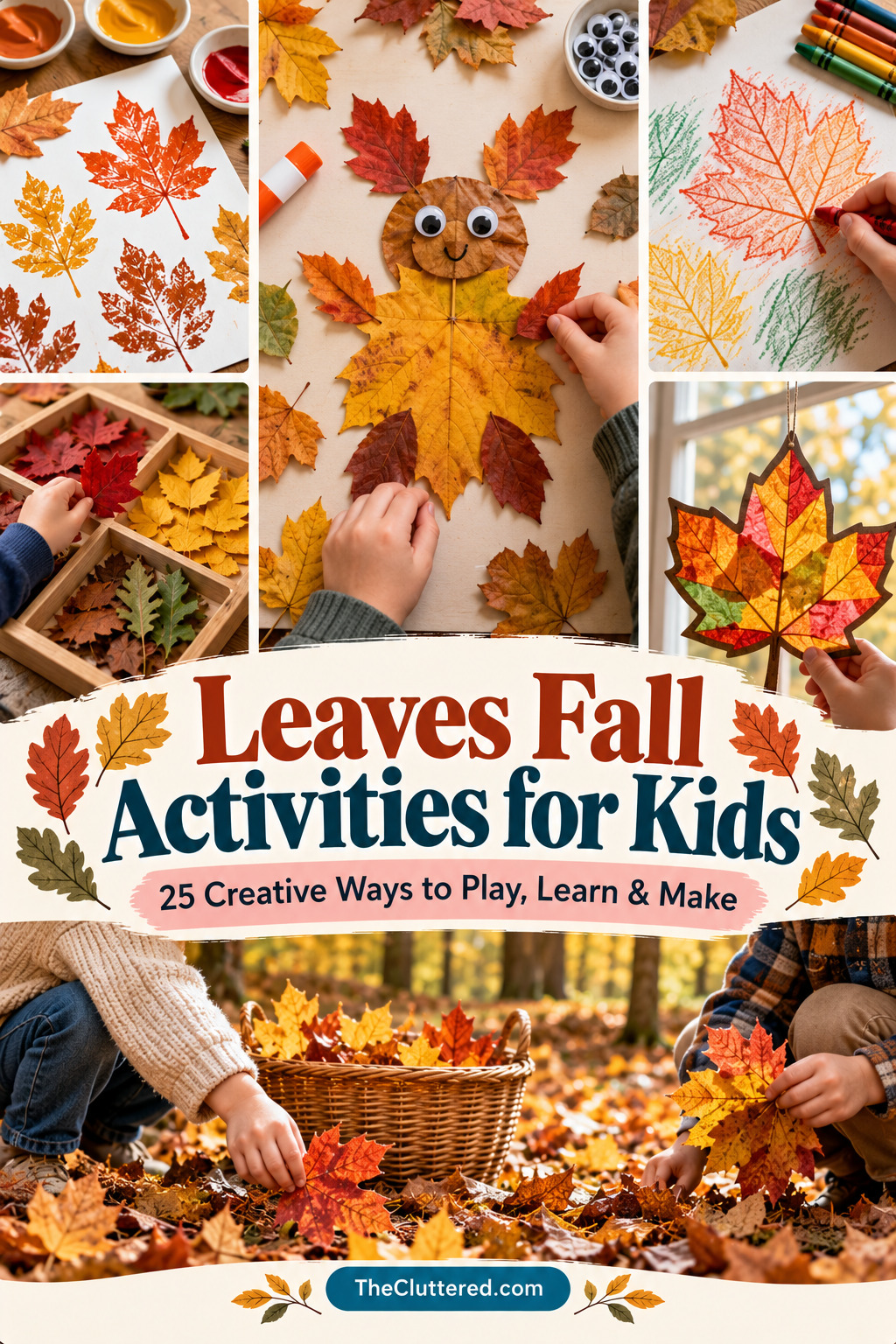


When the ground fills with red, gold, orange, and brown leaves, you already have the makings of a playful afternoon. These leaves fall activities for kids mix simple crafts, outdoor discovery, early-learning games, and easy sensory play—using materials many families can collect on a walk. Choose an idea that fits your child’s age and energy, then let curiosity lead the way.
Quick Start: Choose an Activity That Fits
- For toddlers: supervised leaf collecting, color naming, large-leaf stamping, and a shallow sensory tray with big intact leaves.
- For preschoolers: leaf sorting, matching, crayon rubbings, collages, and simple leaf characters.
- For kindergarten and elementary ages: leaf identification, pattern challenges, observation journals, and questions about why leaves change.
- For rainy days: leaf rubbings, printable matching cards, coloring, and collage art.
- For outdoor time: a color scavenger hunt, a short nature walk, or collecting a few fallen leaves for later projects.
Keep the setup simple. A small collection of fallen leaves, paper, washable paint or crayons, child-safe glue, and a tray are enough for many activities.
1. Start with a Leaf Hunt
Turn a neighborhood walk, backyard visit, or park trip into a gentle scavenger hunt. Ask children to find a yellow leaf, a leaf with a pointed tip, a very small leaf, or two leaves that look different. The goal is noticing—not collecting the biggest pile.
Make it work for different ages
- Toddlers: look for one color at a time and name what you find together.
- Preschoolers: compare large and small leaves or sort a few finds into color groups.
- Older kids: sketch a leaf, compare its edges, or look for several shapes without picking leaves from living plants.
Bring a small paper bag or reusable container if you plan to craft later. Collect only fallen leaves where gathering is allowed, leave wildlife and plants undisturbed, and wash hands after outdoor play.
2. Try Easy Leaf Art and Crafts
Leaf printing
Brush a thin layer of washable paint onto the veined side of a leaf, place it on paper, cover it with scrap paper, and press gently. Lift the leaf to reveal its outline and veins. Test the paint amount on one leaf first; too much paint can blur the details.
Crayon leaf rubbings
Place a dry, flat leaf beneath a sheet of paper with its veins facing up. Hold the paper still and rub the side of a crayon over the area. Try several leaf shapes and compare the patterns that appear.
Leaf collage
Arrange leaves on cardstock before gluing them down. Children can make a tree, a landscape, a pattern, or an abstract design. Let them move pieces around before committing so the activity stays open-ended.
Leaf people and animals
Use a leaf as the body, wings, tail, or hair of a made-up character. Add paper shapes or draw the details rather than relying on tiny loose pieces. Ask children to give their creation a name and describe where it lives.
Leaf suncatchers
Cut a simple leaf outline from paper or use a prepared frame, then fill the center with small pieces of translucent tissue paper. Hang it in a window where daylight can shine through. Adults should prepare cutting steps for younger children.
3. Turn Leaves into Learning Games
Sort by color, size, or shape
Spread a small group of leaves on a table and choose one sorting rule. Children can make a red-and-yellow group, place large leaves apart from small ones, or find leaves with similar edges. Once the rule feels easy, invite the child to invent a new one.
Make a matching game
Pair two leaves that look alike, or use simple leaf pictures if the real leaves are too different. Start with only a few pairs. For a challenge, turn the cards face down and take turns remembering where a match is hiding.
Count and create patterns
Count three leaves into a row, then add one more. Build a repeating pattern such as yellow, red, yellow, red, or arrange leaves from smallest to largest. These quick games combine nature observation with early math without needing a worksheet.
Practice fine-motor skills
Children can place leaves along a drawn path, transfer them with child-safe tongs, or lace a large paper leaf using a blunt lace. Choose materials appropriate to the child’s age, and avoid small parts for children who still mouth objects.
4. Add a Little Leaf Science
Leaves are useful starting points for questions. Why are some leaves still green while others are yellow? Do all leaves have the same edge? Which ones feel smooth, waxy, dry, or brittle? Invite children to predict, observe, and describe before offering an explanation.
- Observe: compare a fresh fallen leaf with a dry one.
- Look closely: use a magnifier to inspect veins and edges.
- Record: draw one leaf and add its color, shape, and collection location.
- Compare: revisit the same tree over several days and notice what changes.
For an observation journal, one page per walk is enough: date, a drawing, a few descriptive words, and one question. The point is careful looking rather than memorizing every tree species.
5. Make a Calm Indoor Leaf Activity Station
On a rainy or busy day, place a small selection of dry leaves, paper, crayons, washable paint, and glue on a washable surface. Offer two choices at a time rather than setting out every supply. A defined work area makes it easier for children to focus and for adults to manage cleanup.
For a toddler sensory activity, use large intact leaves in a shallow tray and stay close throughout play. Avoid leaves from unknown or treated plants, and remove small fragments if they become a choking concern. Never assume a found plant is safe to taste.
Simple Supplies to Gather
- Fallen leaves in a range of shapes and colors
- Plain paper or cardstock
- Washable, child-safe paint and brushes
- Crayons for leaf rubbings
- Child-safe glue or glue sticks
- Scrap paper to protect the work surface
- A shallow tray or reusable container
- A magnifier or notebook, if available
You do not need to buy a special kit. Begin with what you have, and add supplies only when a particular project calls for them.
Leaf Activity Checklist
- Choose an activity suited to the child’s age and attention span.
- Collect fallen leaves where it is permitted.
- Skip leaves that are moldy, thorny, or from unknown plants.
- Check leaves for insects before bringing them indoors.
- Prepare the work surface before opening paint or glue.
- Use washable materials for younger children.
- Offer a small number of leaves at first.
- Let children observe before telling them what to notice.
- Use simple prompts such as “What is different?”
- Keep scissors and cutting steps age-appropriate.
- Supervise toddlers closely during sensory play.
- Avoid small loose parts for children who mouth objects.
- Keep leaves and craft materials away from food.
- Wash hands after collecting and crafting.
- Let artwork dry fully before displaying it.
- Take a photo if a natural item is too fragile to keep.
Frequently Asked Questions
What are the easiest fall leaf activities for toddlers?
Start with a supervised leaf walk, naming colors, sorting a few large leaves, or making a simple print with washable paint. Keep the activity short and avoid small pieces.
How do you preserve leaves for crafts?
For quick projects, use freshly fallen leaves while they are still flexible. To flatten them, place them between sheets of paper inside a heavy book for a short time. Very dry leaves may crumble, so handle them gently.
What can kids do with leaves on a rainy day?
Try crayon rubbings, leaf printing, coloring pages, matching games, a collage, or a leaf observation journal using leaves collected earlier.
How can leaf activities be educational?
Children can practice comparing, sorting, counting, patterning, describing textures, drawing observations, and asking questions about seasonal changes—all through the same natural material.
Should children collect leaves from trees?
Prefer leaves that have already fallen, and follow local park or property rules. Leave living plants and wildlife undisturbed.
Autumn leaves can become art, a matching game, a science prompt, or the beginning of an outdoor adventure. Choose one simple idea, follow your child’s curiosity, and save the remaining leaves for another day.
25 Leaf Activity Ideas to Explore
Browse this visual inspiration gallery for leaf art, playful learning, and simple autumn projects. Each image links to the source URL available in the supplied PinInspector CSV.
🍂 10 Easy Fall Crafts for Kids Using Leaves

Source: Pinterest / original source link
A collection of simple leaf-based art ideas gives families a quick starting point without requiring specialty supplies.
Choose one project first, then gather only the leaves and basic materials it needs.
Try the same idea with different leaf shapes and let the child choose the final arrangement.
Leaf Activities for Preschoolers | Nature Crafts & Learning Ideas | Fall Activities for Kids

Source: Pinterest / original source link
Matching leaves by shape, size, or color turns a nature walk into a playful observation activity.
Start with two or three clear differences for toddlers, then add more choices as children gain confidence.
Keep the first round simple, then add a new color, shape, or rule for an extra challenge.
Leaf-and-Caterpillar Craft

Source: Pinterest / original source link
A leaf character or caterpillar lets children combine found materials with simple arranging and decorating.
Use paper eyes and pipe cleaners with adult help, or substitute drawn details for younger children.
Use adult-prepared materials for younger children and invite older kids to add their own details.
Leaf Collage Art

Source: Pinterest / original source link
Layering leaves of different shapes and colors creates a textured artwork with no single correct result.
Arrange the leaves on paper before gluing so children can change the design as they go.
A piece of cardstock makes the finished work easier to display or save in a nature journal.
Leaf Creature Craft

Source: Pinterest / original source link
Turning leaves into animals encourages children to notice how a leaf’s outline can suggest wings, ears, or a body.
Offer a few examples, then invite kids to invent their own creature rather than copying a model.
Ask the child to explain their creation; their story can be as important as the finished craft.
15 Fun October Arts and Crafts for Kids That Spark Creativity – Postage Master

Source: Pinterest / original source link
A broad fall craft collection can help caregivers choose an activity that fits the time and materials they have.
Pick a project based on the child’s age, attention span, and whether the activity will happen indoors or outside.
Try the same idea with different leaf shapes and let the child choose the final arrangement.
Easy Leaf Printing Art for Kids

Source: Pinterest / original source link
Paint on the veined side of a leaf can transfer its shape and texture onto paper for a bold print.
Use washable paint, press gently, and test one leaf first to see how much paint gives a clear impression.
Keep the first round simple, then add a new color, shape, or rule for an extra challenge.
Tissue Paper Fall Leaves Suncatcher Craft | Fall Crafts for Kids | Crafting a Fun Life

Source: Pinterest / original source link
Translucent tissue paper arranged in a leaf outline creates a bright decoration when daylight shines through it.
Prepare the outline ahead of time for preschoolers and let children choose the tissue-paper color pattern.
Use adult-prepared materials for younger children and invite older kids to add their own details.
Fall Leaf Puzzle Printable for Kids 🍁 Fun Fine Motor Activity

Source: Pinterest / original source link
A leaf picture cut into a few large pieces can become a simple puzzle that practices visual matching.
Begin with two or three pieces and increase the number only when the child is ready.
A piece of cardstock makes the finished work easier to display or save in a nature journal.
Autumn leaf magic wand craft for toddlers

Source: Pinterest / original source link
A sturdy leaf attached to a craft stick can become a wand for storytelling, pretend spells, or a nature parade.
Choose a flexible, undamaged leaf and secure it with tape or string with adult supervision.
Ask the child to explain their creation; their story can be as important as the finished craft.
Leaf-Themed Sensory Play

Source: Pinterest / original source link
Dry leaves offer a seasonal sensory material for supervised sorting, scooping, and describing.
For toddlers, use large intact leaves and supervise closely; remove small pieces if a child mouths objects.
Try the same idea with different leaf shapes and let the child choose the final arrangement.
🍂

Source: Pinterest / original source link
Combining leaves with paper and other collected natural shapes invites children to experiment with composition.
Collect only fallen leaves where permitted and avoid unknown berries, mushrooms, or irritating plants.
Keep the first round simple, then add a new color, shape, or rule for an extra challenge.
Nadia Amir

Source: Pinterest / original source link
Paper tree trunks and loose leaves make it easy for children to represent how trees change in fall.
Use paper scraps, dot markers, or glue to add leaves, adapting the fine-motor demand to the age group.
Use adult-prepared materials for younger children and invite older kids to add their own details.
Leaf Hunt and Collection

Source: Pinterest / original source link
A short leaf hunt gives children a purpose for looking closely at color, shape, and size outdoors.
Make a simple list such as red, yellow, large, and tiny, and let children mark each discovery with a drawing.
A piece of cardstock makes the finished work easier to display or save in a nature journal.
19+ Creative Fall Leaves Crafts For Kids To Try This Fall – CuteEasy

Source: Pinterest / original source link
Simple leaf crafts work well when children can make choices without following many steps.
Set out a small tray of materials and demonstrate one technique before letting children explore.
Ask the child to explain their creation; their story can be as important as the finished craft.
Fall leaf printing

Source: Pinterest / original source link
Painting leaves or using them as stamps combines color choice with close observation of natural patterns.
Try one color at a time or overlap two colors to compare the prints.
Try the same idea with different leaf shapes and let the child choose the final arrangement.
Leaf Drawing and Rubbing

Source: Pinterest / original source link
Placing paper over a leaf and rubbing a crayon across it can reveal the leaf’s outline and veins.
Use a flat, dry leaf and hold the paper still; try different crayon angles for varied results.
Keep the first round simple, then add a new color, shape, or rule for an extra challenge.
Leaf printing that toddlers can’t stop doing try today

Source: Pinterest / original source link
Pressing a painted leaf onto paper lets toddlers explore cause and effect through a visible print.
Tape the paper to the table, offer washable paint, and keep the session short and supervised.
Use adult-prepared materials for younger children and invite older kids to add their own details.
Build a Fall Leaf Person Printable Craft for Kids

Source: Pinterest / original source link
A leaf person combines natural shapes with drawn or paper facial features for an approachable craft.
Invite children to name their character and tell a short story about where it lives.
A piece of cardstock makes the finished work easier to display or save in a nature journal.
Leaf Art Ideas

Source: Pinterest / original source link
Leaf art can range from printing to collage, rubbing, and simple arranging, giving children several ways to participate.
Display the finished pieces together to compare how the same material can make different results.
Ask the child to explain their creation; their story can be as important as the finished craft.
Sonbahar Eşleştirme Etkinliği

Source: Pinterest / original source link
Leaf pictures or real leaves can be paired by outline, color, or size as an early visual-discrimination game.
Keep the first set small and use clearly different examples before introducing look-alike leaves.
Try the same idea with different leaf shapes and let the child choose the final arrangement.
25 Fall Leaf Crafts for Kids Using Real Leaves

Source: Pinterest / original source link
Using fallen leaves makes a craft feel connected to an outdoor discovery and encourages children to look more closely at nature.
Press leaves briefly between paper if they are damp, and use them soon before they become brittle.
Keep the first round simple, then add a new color, shape, or rule for an extra challenge.
35 Easy Fall Crafts for Kids (Cute Autumn Ideas)

Source: Pinterest / original source link
A varied set of seasonal craft examples can help families plan a calm afternoon or classroom activity.
Prepare messy materials in advance and let the child make the main creative choices.
Use adult-prepared materials for younger children and invite older kids to add their own details.
Leaf Threading Activity for Kids in Fall

Source: Pinterest / original source link
Threading or lacing around a leaf shape supports hand-eye coordination when the materials are sized for the child.
For young children, use a large paper leaf and a blunt, child-safe lace; avoid small loose parts for toddlers.
A piece of cardstock makes the finished work easier to display or save in a nature journal.
Color The Leaves Kids Coloring Activity Free Printable

Source: Pinterest / original source link
Coloring leaf shapes is a low-mess option for rainy days or a transition between active play and quiet time.
Invite children to use real leaves as color references, or invent their own imaginative palette.
Ask the child to explain their creation; their story can be as important as the finished craft.
Love these ideas? Follow @theclutteredblog on Pinterest for more cozy, practical gift inspiration!