


















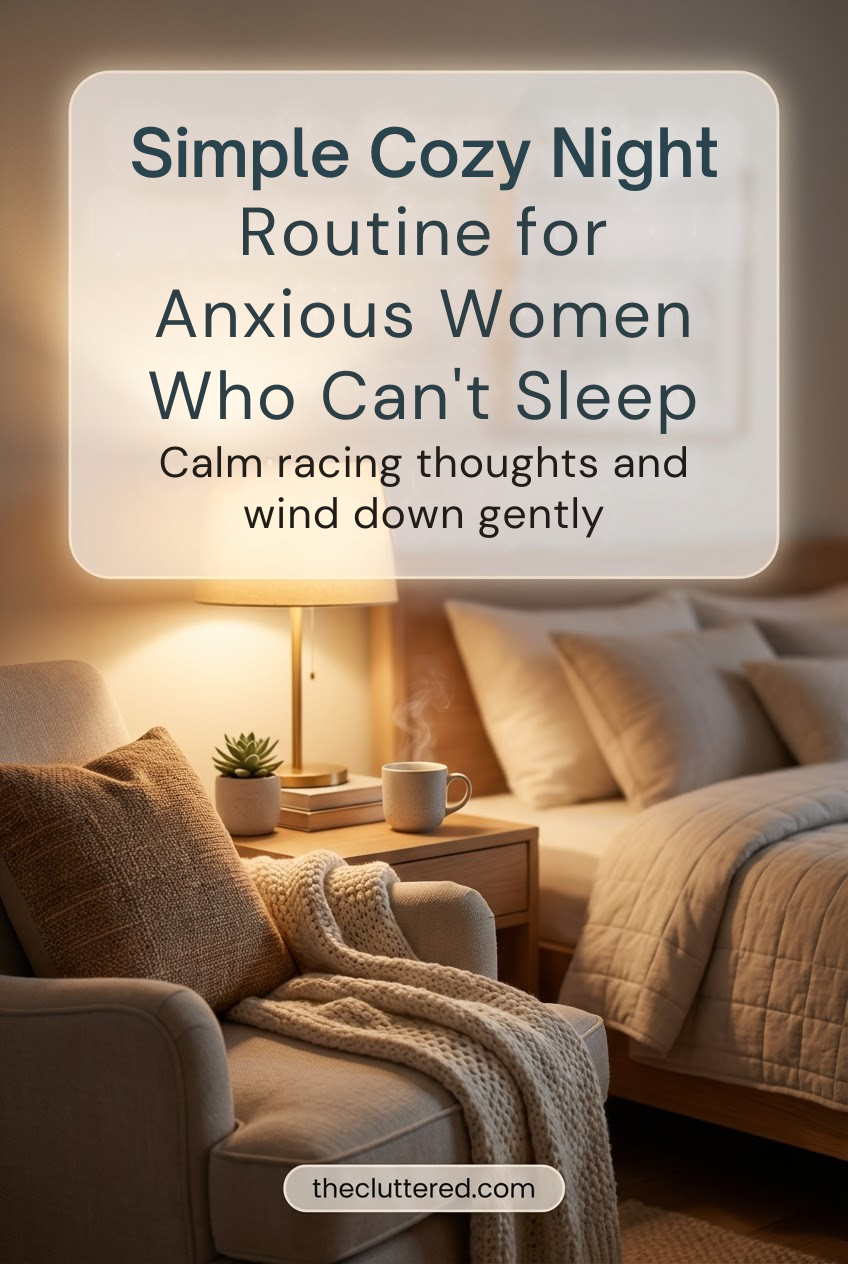
If your brain hits overdrive the moment your head hits the pillow, you’re not alone. Nighttime can be the hardest for anxious women who can’t sleep—your body is exhausted but your mind is suddenly replaying every conversation, worry, and to‑do. A simple cozy night routine for anxious women who can’t sleep is not about perfection or “that girl” aesthetics; it’s about giving your nervous system a soft landing so it finally feels safe enough to rest. In this guide, you’ll get an anxiety‑friendly evening routine, calming bedtime habits, a practical night routine checklist, and cozy self‑care ideas you can actually stick to. Save this guide to come back to on your hardest nights—and don’t forget to follow @theclutteredblog on Pinterest for more calm, cozy routines.


A Soft Snapshot of This Cozy Night Routine
- Made for anxious women who can’t sleep, especially on busy, overwhelmed, or seasonal stress nights.
- Focuses on a simple cozy night routine that’s gentle, low‑pressure, and realistic for tired brains.
- Walks you through a step‑by‑step bedtime routine for anxiety that takes 45–90 minutes (and can be shortened on low‑energy days).
- Includes a night routine checklist you can turn into a printable or Pinterest pin for quick reference.
- Gives tons of cozy night routine ideas for different moods: busy days, low‑energy nights, Sunday reset evenings.
- Helps you build anxiety‑friendly night habits slowly, without perfectionism or rigid rules.

What a Simple Cozy Night Routine Is (and Why It Helps Anxiety)
A simple cozy night routine for anxious women who can’t sleep is a gentle sequence of small habits you repeat most evenings to help your brain and body slowly unwind. Instead of going from bright screens and mental overload straight into bed, you walk yourself through calming cues—like warm light, soft textures, and grounding practices—that tell your nervous system, “You’re safe now, you can rest.” It’s less about a rigid bedtime routine and more about a cozy slow‑living night rhythm that feels kind to you.
This kind of anxiety‑friendly night routine matters because anxiety thrives on sudden transitions, overstimulation, and uncertainty. When you scroll until midnight or answer emails in bed, your mind stays in “problem‑solving” mode, which makes it a lot harder to fall asleep. A cozy evening routine breaks that pattern and builds predictable signals your body can learn to recognize over time.
What this routine is not:
- It’s not a strict schedule with 15 steps you must follow perfectly.
- It’s not a productivity hack or a way to “earn” sleep by doing more.
- It’s not an all‑or‑nothing program—on hard nights, you can do just one or two steps.
What this routine can be:
- A slow, safe bridge between a stressful day and actual rest.
- A way to calm nighttime anxiety without needing a huge amount of energy.
- A flexible framework you can adapt for busy moms, students, shift workers, or seasonal routines (like a winter cozy night routine or Sunday reset evenings).
Key Elements of a Solid Cozy Night Routine for Anxiety
A cozy night routine that supports anxious women who can’t sleep usually has a few core pillars. You can customize the details, but these elements help the routine feel grounding instead of overwhelming.
1. A Clear Wind‑Down Window
What it is:
A loose timeframe—usually 45–90 minutes before bed—when you start intentionally shifting out of “day mode” and into “night mode.”
Why it matters:
Anxiety loves when you go from high‑stimulation to trying to sleep in one jump. A defined wind‑down window gives your body time to catch up and tells your brain it doesn’t have to keep performing.
Example:
If you want to be in bed by 11 p.m., you might start your cozy night routine around 9:45 or 10 p.m.: dim lights, close your laptop, and put your phone on Do Not Disturb.
2. A Gentle Mind‑Clear Ritual
What it is:
A small practice that gets racing thoughts out of your head and onto something else—like paper, an app, or even a voice note.
Why it matters:
Nighttime anxiety often shows up as overthinking, replaying the day, and mentally working through tomorrow’s tasks. A simple “brain dump” or worry list helps your mind feel like nothing important will be forgotten, so it can relax.
Example:
You set a 5‑minute timer, jot down everything on your mind, then pick 3–5 things for tomorrow’s priority list. You remind yourself: “The rest can wait.”
3. A Cozy Body‑Soothing Segment
What it is:
A part of your bedtime routine for anxiety that focuses on physical comfort and nervous system regulation—warmth, soft fabrics, stretching, or a shower.
Why it matters:
It’s hard for anxious women to feel calm in a tense, restless body. Soothing your body first (before lying in bed) makes it easier to use mindset tools later.
Example:
You take a warm shower, put on breathable soft pajamas and cozy socks, then stretch for 3–5 minutes while listening to calm music.
4. One Grounding Practice for Your Mind
What it is:
A short, repetitive practice that gently redirects your focus and slows your thoughts.
Why it matters:
You don’t need a 40‑minute meditation. One simple grounding technique—done consistently—can have a big impact on bedtime anxiety and sleep quality.
Example:
You do 4–7–8 breathing (inhale 4, hold 7, exhale 8) for 5 cycles, or a body scan where you notice and soften each part of your body from toes to head.
5. A Soft, Non‑Stimulating “Last Activity”
What it is:
The final thing you do before closing your eyes: reading, listening to something, or repeating a mantra.
Why it matters:
Ending with something gentle helps your brain associate bed with safety and quiet comfort instead of doom‑scrolling or decision‑making.
Example:
You read a light novel, listen to a soothing podcast, or repeat a simple affirmation like, “I’ve done enough for today. It’s safe to rest now.”

Step‑by‑Step Guide to Creating Your Simple Cozy Night Routine
Step 1: Choose Your Wind‑Down Window
What this step is for:
To give your brain a predictable cue that “we’re done for today” and to stop trying to flip from high alert straight into sleep.
How to do it:
Look at your usual bedtime and count backwards 45–90 minutes. That’s your ideal cozy night routine window. If you’re a busy mom or student, this might be shorter—30 minutes still helps. During this time, avoid starting anything intense: no big work tasks, deep relationship talks, or heavy shows. You’re not being lazy, you’re being intentional with your energy. Even dimming lights and closing extra tabs counts as starting your evening routine for anxiety.
Extra tips:
- If your schedule changes, just pick a wind‑down window “for tonight” instead of stressing about consistency.
- Link it to an anchor, like “after the kids’ bedtime” or “after I turn off my laptop.”
Step 2: Do a 5–10 Minute Brain Dump
What this step is for:
To get spinning thoughts out of your head and into a safe place so your mind doesn’t have to keep holding everything.
How to do it:
Set a timer for 5–10 minutes. In a notebook or notes app, write down anything that’s making your brain feel loud: worries, to‑dos, things you’re scared you’ll forget, conversations you’re replaying. Don’t organize or judge it; just get it out. When the timer ends, draw a line and choose 3–5 items that truly matter tomorrow. Put those on a simple “tomorrow list.”
Example:
You might write: “email boss, pay bill, text mom, anxiety about appointment, feeling behind on laundry…” Then you choose: email boss, pay bill, call doctor. The rest can wait, and your brain knows it’s captured.
Common mistakes:
- Trying to solve every problem right now—remember, this is parking, not fixing.
- Doing your brain dump in bed (do it earlier in the wind‑down window instead).

Step 3: Add a Cozy Body Ritual
What this step is for:
To help your body release physical tension so your mind doesn’t have to fight against a tense, wired system.
How to do it:
Choose one body‑focused ritual that feels realistic most nights. It could be a warm shower, a short bath, five minutes of stretching, or even just slowly applying moisturizer or oil to your hands and feet. Keep the lights low and the environment gentle—no bright bathroom lights if you can avoid it. If you live in a small space or share a room, even slipping into soft pajamas and doing neck stretches can be enough.
Example:
You take a 7‑minute shower, focusing on the sensation of water on your shoulders, then put on your coziest sleep shirt and socks. You roll your shoulders a few times and take three deep breaths before leaving the bathroom.
Extra tips:
- Pick something that doesn’t require a lot of steps or decisions.
- Keep any products or tools you use in a small night caddy so it’s easy to start.
Step 4: Pick One Grounding Practice for Your Mind
What this step is for:
To gently bring your thoughts from “everywhere” back into your body and the present moment.
How to do it:
Instead of trying every technique, pick one grounding tool you’ll lean on most nights. For example, 4–7–8 breathing, a short guided meditation, a body scan, or progressive muscle relaxation. Set a timer for 3–10 minutes and let that be enough. You’re not aiming for “no thoughts,” just a slightly quieter, softer mental space.
Example:
You sit on your bed, place one hand on your chest and one on your stomach, and practice 4–7–8 breathing for five cycles. When your mind wanders, you simply note “thinking” and come back to the count and the feeling of your hands.
Common mistakes:
- Judging yourself for “doing it wrong” if your mind wanders. Wandering is normal. The coming back is the practice.
- Only using grounding techniques on crisis nights—instead of using them preventively as a gentle habit.
Step 5: Set Up a Sleep‑Friendly Bedroom
What this step is for:
To make your space feel safe, calm, and less likely to trigger more anxiety the second the lights go out.
How to do it:
Turn off harsh overhead lights and use warm lamps or fairy lights. Clear anything from your bed that doesn’t need to be there (laundry, bags, open laptops). If clutter stresses you out, pick one tiny thing to relocate—like moving a pile from your nightstand to a basket to deal with tomorrow. Adjust your room temperature so you feel slightly cool under the blanket. If it helps, turn on a fan, white noise, or soft ambient sounds.
Example:
You switch on a salt lamp, put your phone on a dresser across the room, throw extra clothes into a hamper, and straighten your blanket. It doesn’t look like a magazine spread—but it feels safer and cozier.

Step 6: End With a Soft, Kind Final Activity
What this step is for:
To let your brain land on something gentle instead of anxiety or “just one more scroll.”
How to do it:
Choose one non‑stimulating activity that feels comforting: reading a light book, listening to a cozy podcast, doing a page in a low‑pressure journal, or simply repeating an affirmation. Keep screens off or on very low brightness with blue light filters. When you notice yourself wanting to open apps, gently tell yourself, “We’re closing the day now. This is my rest time.”
Example:
You read 5–10 pages of a calming book and then set it down, saying to yourself, “I’ve done enough. It’s safe to rest, even if my sleep isn’t perfect.”
Practical Cozy Night Routine Ideas and Variations
You don’t have to run the exact same night routine every single evening. Here are flexible ideas you can plug into your simple cozy night routine for anxious women who can’t sleep, depending on your mood, energy, and season.

On Busy Weeknights
- 10‑minute “mini routine”: dim lights, 5‑minute brain dump, 3 rounds of deep breathing, soft playlist while you get into bed.
- Do your brain dump in the car or commute notes app so your wind‑down at home can be shorter.
- Choose one sensory comfort (warm tea, fuzzy socks, weighted blanket) and one grounding practice.
On Low‑Energy, “I Can Barely Function” Nights
- Skip the bath and just wash your face with warm water and put on your comfiest t‑shirt.
- Do a lying‑down body scan or simply focus on feeling your feet on the mattress.
- Let your “routine” be: no doom‑scrolling, one kind sentence to yourself, lights low.
On Cozy Weekend or Sunday Reset Nights
- Add a longer bath with soft music, candles, or dim lights.
- Do a gentle weekly reflection: “What drained me? What supported me? What do I want more of next week?”
- Plan a loose Sunday night routine that includes fresh sheets, a tidy nightstand, and a calming show or book.
For Moms and Caregivers
- Start your routine once everyone else is in bed—even if it’s short.
- Keep a “bedside brain dump notebook” so you don’t have to get up when you remember something for the kids tomorrow.
- Use tag‑team nights if you can: one partner does bedtime while the other starts their own wind‑down, then swap another night.
For Students or Work‑From‑Home Women
- Create a visual “end of work” ritual: close your laptop, put it out of sight, and physically leave the workspace.
- Use a calming playlist you only play during your cozy night routine to train your brain that this sound = winding down.
- On deadline nights, still do a 5‑minute version: brain dump, stretch, and one grounding practice before bed.

How to Make Your Cozy Night Routine Stick
The biggest secret to a sustainable bedtime routine for anxiety? Keep it small and kind. Your routine should feel like support, not punishment.
Some mindset shifts that help:
- Aim for “most nights,” not “every night.” If you miss a night, you’re not starting over—you’re just picking back up.
- Measure success by how you show up, not how fast you fall asleep. The routine is still working even if sleep takes time; you’re teaching your nervous system new patterns.
- Let your routine flex with your seasons. Your winter cozy night routine might look different from your busy summer weeknights.
A simple affirmation you can borrow:
“I don’t have to fix everything tonight. I just have to give myself a softer landing.”

Save‑Friendly Visuals: How to Use the Pins and Printables
Think of the visuals connected to this cozy night routine as little anchors you can lean on when your brain feels too tired to remember the steps.
You can:
- Save the quick overview checklist pin as your main reference for anxious nights.
- Use the step‑by‑step routine pin when you want to follow the bedtime routine for anxiety in order.
- Save the ideas list pin to mix things up on weekends or low‑energy days.
- Print or screenshot the setup checklist to keep beside your bed as a tiny night routine tracker.
Next Steps: Start Gentle, Not Perfect
You don’t need to overhaul your entire life to feel a difference at night. Pick just 2–3 pieces from this simple cozy night routine for anxious women who can’t sleep and try them for the next week: maybe a brain dump, a cozy body ritual, and one grounding practice. Notice how your evenings feel, not just how quickly you fall asleep.
Save this post to your “Night Routine” or “Self‑Care” board so you can come back on the nights when your brain feels too foggy to think. And if you want more calm, cozy, practical routines like this, follow @theclutteredblog on Pinterest.
FAQs About a Simple Cozy Night Routine for Anxious Women
What if I don’t have 60–90 minutes for a night routine?
You absolutely don’t need that much time. A simple 10–15 minute mini routine—dim lights, quick brain dump, one grounding practice—is still a powerful anxiety‑friendly night routine. The goal is a little consistency, not big dramatic evenings.
What if my anxiety actually gets worse when I slow down?
That’s normal at first. When you remove distractions, your brain finally has space to show you what’s been under the surface. Start with very short practices (2–3 minutes), keep your hands gently busy (like holding a mug or blanket), and consider pairing your routine with therapy or support if it feels overwhelming.
Can I still use my phone before bed?
You can, but try to set boundaries: no heavy content, no arguing, no work apps. Use your phone for calming, predictable things only (like a specific playlist or meditation app), and ideally stop active scrolling 20–30 minutes before sleep.
What if I live in a small or shared space?
Your cozy night routine can be tiny and portable: a lamp by your bed, a small basket for your nightly items, noise‑canceling headphones, or an eye mask. Focus on what you can control in your immediate bubble—light, sound, and one or two comforting objects.
What if I try this and still can’t sleep?
Sleep is complex, and routines are just one piece. Even if you’re not falling asleep quickly yet, you’re still teaching your nervous system that nights can be softer and safer. If insomnia or anxiety is severe or long‑term, consider talking with a professional about additional support—this routine can be a helpful partner, not the only tool.
Closing thought: you don’t have to earn rest by doing everything right. Start where you are, with the energy you have, and let your cozy night routine grow with you. Save this guide, and follow @theclutteredblog on Pinterest for more slow, gentle ways to take care of yourself at night.