

















When your joints hurt, the idea of “doing cardio” can feel like the last thing you want to try. Maybe running or jumping workouts have left your knees or hips throbbing in the past, or you’re nervous that exercise will make things worse. The good news: low-impact cardio is specifically designed to get your heart rate up without pounding your joints, and it’s often recommended for beginners, people with arthritis, and those returning after injury.
This guide will walk you through what low-impact cardio actually is, why it’s helpful for joint pain, nine gentle beginner-friendly options, and a simple starter plan you can follow—even if you’re feeling anxious about moving again.
What Is Low-Impact Cardio?
“Low-impact” means your body is not repeatedly leaving and slamming back down onto the ground. At least one foot stays on the floor at a time or your body weight is supported by water or a machine, which reduces stress on the knees, hips, ankles, and spine.
Examples of high-impact vs. low-impact:
- High-impact: running, jumping jacks, burpees, plyometric circuits.
- Low-impact: walking, cycling, swimming, elliptical, controlled step moves, seated marches.
You can still get your heart rate up, build endurance, and feel fitter with low-impact cardio; you’re just protecting your joints while you do it.
Why Low-Impact Cardio Helps Joint Pain
Done correctly, low-impact cardio can reduce pain over time instead of increasing it. Here’s why:
- Less pounding on cartilage and joint surfaces – Smooth, gliding movements or supported exercises put less mechanical stress through your knees, hips, and ankles.
- Stronger muscles = better support – As your leg, core, and hip muscles get stronger, they help stabilize and protect your joints.
- Improved circulation and lubrication – Gentle movement helps bring nutrients to your joints and can reduce stiffness, especially for arthritis.
- Better overall health and mood – Cardio supports heart health, weight management, and mental wellbeing, which all have an indirect impact on joint comfort.
If you’re under medical care or have been told you have significant joint damage, always clear new exercise with your doctor or physiotherapist first.
Safety Tips Before You Start
Especially for beginners with joint pain, a few safety rules go a long way:
- Pain scale, not zero: Some mild discomfort or muscle fatigue can be normal, but sharp, stabbing, or worsening joint pain is a red flag.
- Warm up for 5 minutes: Start each session with very gentle movement (slow walking, easy marching, or joint circles) to get blood flowing.
- Progress gradually: Increase either time or intensity, not both at once—and only by a small amount per week.
- Supportive shoes: Use cushioned, supportive footwear for any standing exercises to reduce stress on your knees and feet.
- Use stable support: A sturdy chair, countertop, or rail is your friend when balance is an issue.
If you notice swelling, warmth, or pain that lingers or worsens after exercise, scale back and talk with a professional.

9 Best Low-Impact Cardio Options for Joint Pain Beginners
You do not have to use all of these. Start with 1–3 that feel least scary and build from there.
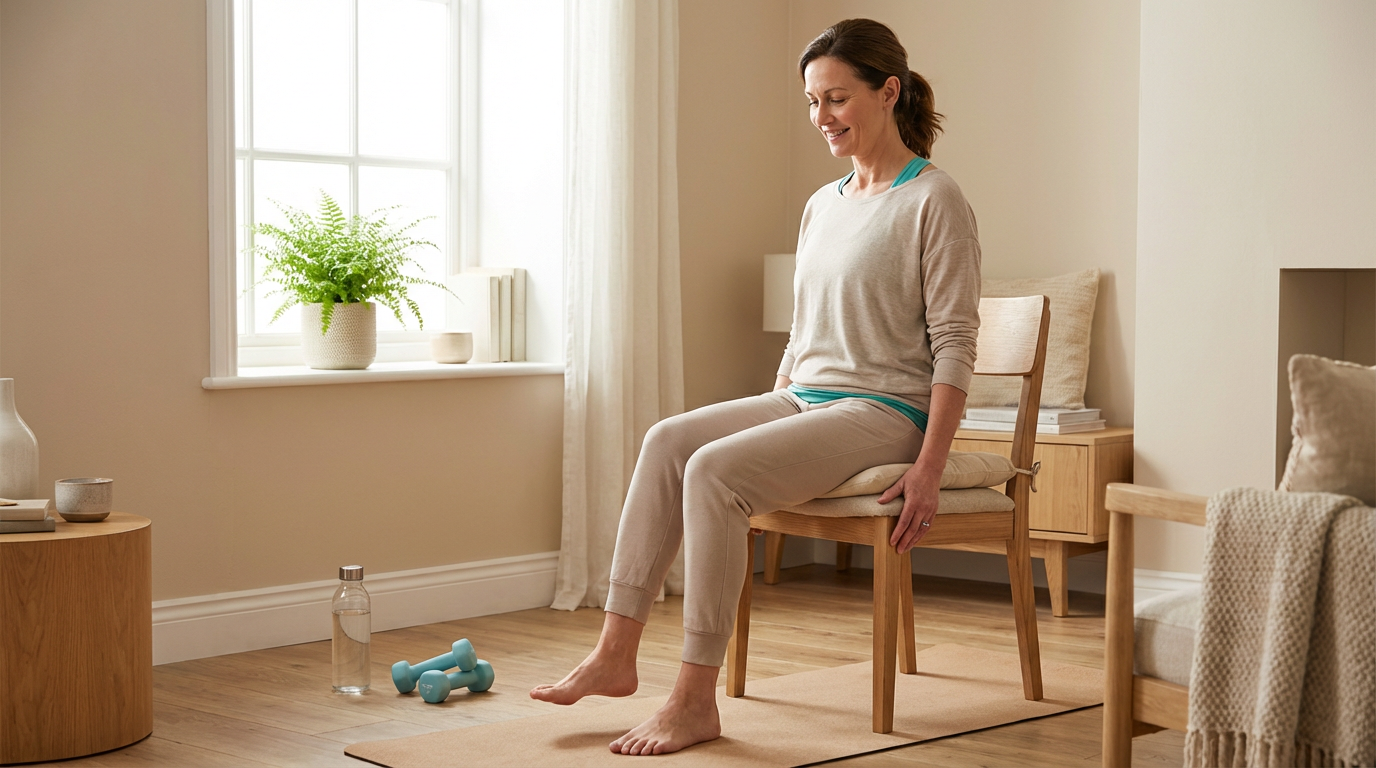
1. Seated Marches
Perfect if standing is painful or you’re very deconditioned.
- Sit tall in a sturdy chair, feet flat on the floor.
- Gently lift one knee a few centimeters, set it down, then switch legs like a slow march.
- Swing your arms lightly if comfortable to increase your heart rate.
Start with 1–2 minutes, rest, and repeat. This is a great warm-up or a full mini-cardio option on very painful days.
2. Easy Indoor Walking
Walking is often recommended as the first low-impact cardio step for joint pain.
- Walk in your house, hallway, or around your yard at a comfortable pace.
- Keep steps light, roll from heel to toe if your joints allow.
- Relax your shoulders and keep your gaze forward, not down at your feet.
Begin with 5 minutes and add 1–2 minutes every few sessions, aiming for 10–20 minutes over time.
3. Side Step Touches
A simple way to bring your heart rate up without jumping.
- Stand tall, feet hip-width apart, near a chair or wall if balance is tricky.
- Step your right foot out to the side, then bring your left foot in to meet it.
- Repeat side-to-side, gently swinging your arms.
Try 30–60 seconds, rest, and repeat for 3–5 rounds.
4. Low-Impact March with Arm Reach
Combines lower and upper body for more cardio effect.
- March in place with light steps.
- Slowly reach your arms forward, out to the side, or slightly overhead, staying in a pain-free range.
- Keep your core gently engaged and your jaw and neck relaxed.
Use short intervals (e.g., 30 seconds on, 30 seconds off) for 5–10 minutes total.
5. Gentle Step-Ups on a Low Step
Good for building functional strength for stairs—start very small.
- Stand facing a very low step or the bottom stair, holding a railing or chair.
- Step up with your right foot, then left, then step down right, then left.
- Move slowly and deliberately; avoid jerky motions.
If one knee is more painful, step up with the stronger leg first. Limit range if you feel joint discomfort.
6. Wall or Counter Push-Offs
Upper-body-focused but still raises heart rate.
- Stand at arm’s length from a wall or sturdy counter.
- Place hands on the surface, lean in like a gentle push-up, then push back to standing.
- Keep your body in a straight line and move slowly.
Start with 8–10 repetitions, rest, and repeat once or twice.
7. Stationary Cycling (Bike)
Cycling is a classic joint-friendly cardio option.
- Use an upright or recumbent bike; adjust the seat so your knee is slightly bent at the bottom of the pedal stroke.
- Start with very low resistance and an easy pace.
- Focus on smooth circles, not stomping on the pedals.
Begin with 5–10 minutes and build toward 20–30 minutes as tolerated.
8. Water Walking or Aqua Aerobics
Water is one of the best environments for painful joints.
- In waist- to chest-deep water, walk forward and backward.
- The water supports your body weight, reducing impact, while providing gentle resistance.
- Join an aqua class designed for arthritis or beginners if you like group settings.
This is ideal when land-based exercises are too uncomfortable.
9. Elliptical or Gentle Rowing Machine
For some, machines add variety without extra impact.
- Elliptical: Choose low resistance and pace; the smooth, gliding motion avoids impact.
- Rowing machine: Keep resistance low, focus on technique, and stop if you feel back or knee strain.
Not everyone with joint pain will tolerate these, so listen to your body.
Simple Beginner Low-Impact Cardio Plan (Weeks 1–4)
You can treat this as a gentle template, adjusting time and moves as needed.
Week 1–2 (2–3 sessions per week)
- 3 minutes: Easy indoor walking or seated marches (warm-up).
- 2 minutes: Side step touches.
- 2 minutes: Low-impact march with arm reach.
- 3–5 minutes: Stationary cycling or more walking.
- 2 minutes: Cool-down walk + light stretching.
Total: about 10–14 minutes.
Week 3–4 (3 sessions per week)
- 5 minutes: Easy walking or cycling warm-up.
- 3 x 1 minute: Side step touches with 30–60 seconds rest between.
- 3 x 1 minute: Low-impact march + arm reach with 30–60 seconds rest.
- 5–10 minutes: Stationary cycling or water walking if available.
- 3 minutes: Cool-down and gentle stretching.
Total: 18–25 minutes. Increase by just a few minutes per week, not all at once.
When to Pause and Get Help
Stop and consult a professional if you notice:
- Sharp, stabbing, or sudden joint pain that doesn’t ease with rest.
- Significant swelling, redness, or warmth around the joint.
- Feeling like the joint might “give out” or lock.
A physiotherapist, sports doctor, or orthopaedic specialist can help tailor a plan to your specific joints and diagnosis.
Key Mindset for Beginners with Joint Pain
- Moving a little is better than not moving at all.
- Progress might be slow—but slow is still progress.
- You can adjust how long, how often, and what type of cardio you do; nothing is “all or nothing.”
Think of low-impact cardio as a long-term investment in your joints, energy, and independence, not a quick fix.