









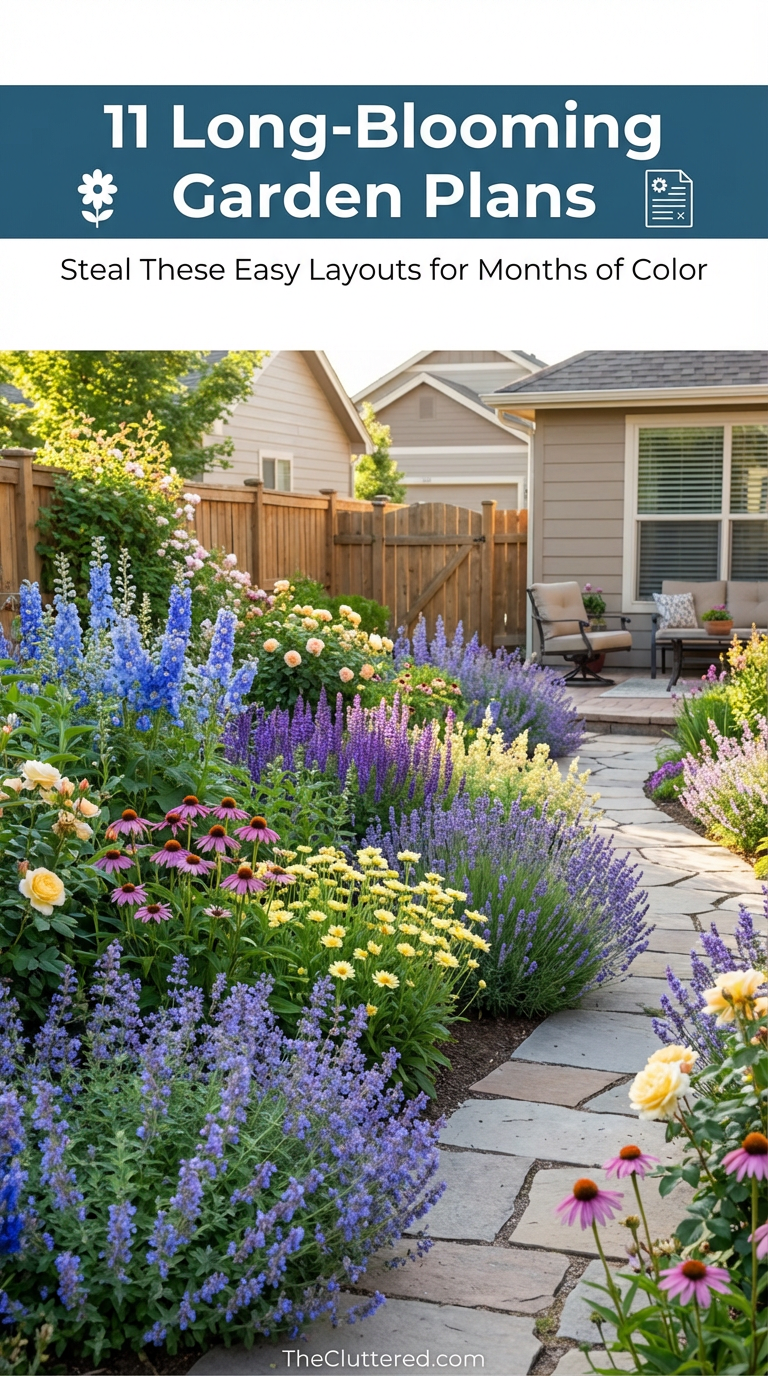


FLOWER BEDS THAT WORK HARD
11 Long-Blooming Garden Plans for Effortless Color All Season
Want flowers that don’t quit after one pretty weekend? These long-blooming garden layouts are designed to keep color rolling from the first warm days of spring straight through fall frost.
How Long-Blooming Garden Plans Actually Work
A long-blooming garden is less about stuffing in more plants and more about layering bloom times, heights, and textures so there’s always something doing the heavy lifting.
1. Layer bloom times like a calendar
Start with early spring stars, add summer workhorses, and finish with fall powerhouses so each month has at least one plant in its prime.
When you stack these “seasons of interest,” any awkward gap where the garden looks tired gets filled in automatically.
2. Mix perennials, shrubs, and annuals
Perennials bring reliable structure, flowering shrubs add big moments of color, and annuals slip into open spaces to extend bloom when another plant takes a break.
3. Use repeat colors to make it look intentional
Long-blooming beds can get visually noisy, so choose a small palette—like blues, purples, and whites—and echo those colors from one end of the bed to the other.
Repeating color and plant groupings helps your eye read the border as one cohesive scene instead of a random plant collection.
4. Design for views you actually see
Place your longest-blooming and highest-impact plants where you look most often: along the curb, near the front walk, outside your favorite window, or around a patio.
11 Long-Blooming Garden Layouts You Can Steal
Use these idea-driven plans as inspiration, then adjust plant choices to match your climate, sun, and personal style.
Year-Round Excitement Border
Build a mixed border with spring bulbs, reblooming daylilies, long-flowering perennials, and a few structural shrubs so something always looks fresh.
Layer taller shrubs and perennials in the back, mid-height bloomers in the center, and a soft edge of groundcovers along the lawn.
Curbside Color Garden
Combine sun-loving perennials such as coneflowers and black-eyed Susans with ornamental grasses for a border that stays interesting even after petals drop.
Repeat your favorite plant in small drifts along the whole strip to make this narrow bed feel like one continuous ribbon of color.
Roses in the Round
Center a fragrant shrub rose, then circle it with long-blooming companions like salvias and catmint that hide bare rose legs and attract pollinators.
Keep colors soft and harmonious so the rose stays the star while the supporting cast quietly fills the season.
Heat-Proof Color Band
For exposed areas that bake in summer, lean into drought-tolerant plants with long bloom periods such as blanket flower, yarrow, and Russian sage.
Add gravel mulch instead of bark so heat-loving plants stay happy and the bed still looks tidy during dry spells.
Long-Blooming Rock Border
Tuck low-growing perennials between stones—like creeping thyme and rock cress—to spill over edges and extend bloom time in a sunny rock garden.
Mix in a few compact shrubs to anchor the space so the bed doesn’t disappear when earlier bloomers finish.
Cool-Blue Theme Garden
Build a soothing, mostly-blue palette using plants such as amethyst flower, blue salvia, and other sky-toned perennials for a unified, calming look.
Sneak in a few silver or white accents so the blues read brighter from your window or patio seating.
Entertaining-Ready Flower Strip
Surround your seating area with long-blooming, lightly scented plants so every gathering comes with color and fragrance built in.
Choose varieties that don’t drop messy petals all at once to keep the patio low-maintenance.
Soft Shade Season-Extender
In shadier spots, rely on foliage stars and long-lasting spring bloomers such as hellebores and Siberian bugloss to carry the border.
Layer textures and leaf colors so the bed looks full even when bloom windows are shorter.
Low-Fuss Side Garden
Combine tough, long-blooming perennials with a few ornamental grasses for a narrow border that thrives on minimal attention.
Repeat just three to five plants down the length of the bed so maintenance stays simple.
Late-Season Color Boost
Focus this plan on late-summer and fall bloomers—think asters, mums, and ornamental grasses—to take over when earlier plants fade.
Add a few berrying shrubs so color continues even after the last blossom drops.
All-Season Front Border
Mix evergreens, spring bulbs, summer perennials, and fall-blooming plants in one front border to keep your home’s entry feeling dressed year-round.
Use one standout shrub near the door as your “anchor” so the composition still feels strong in winter.
Long-Blooming Garden Setup Checklist
Use this quick checklist as your planning cheat sheet before you buy a single plant. Screenshot, print, or keep it open on your phone while you design.
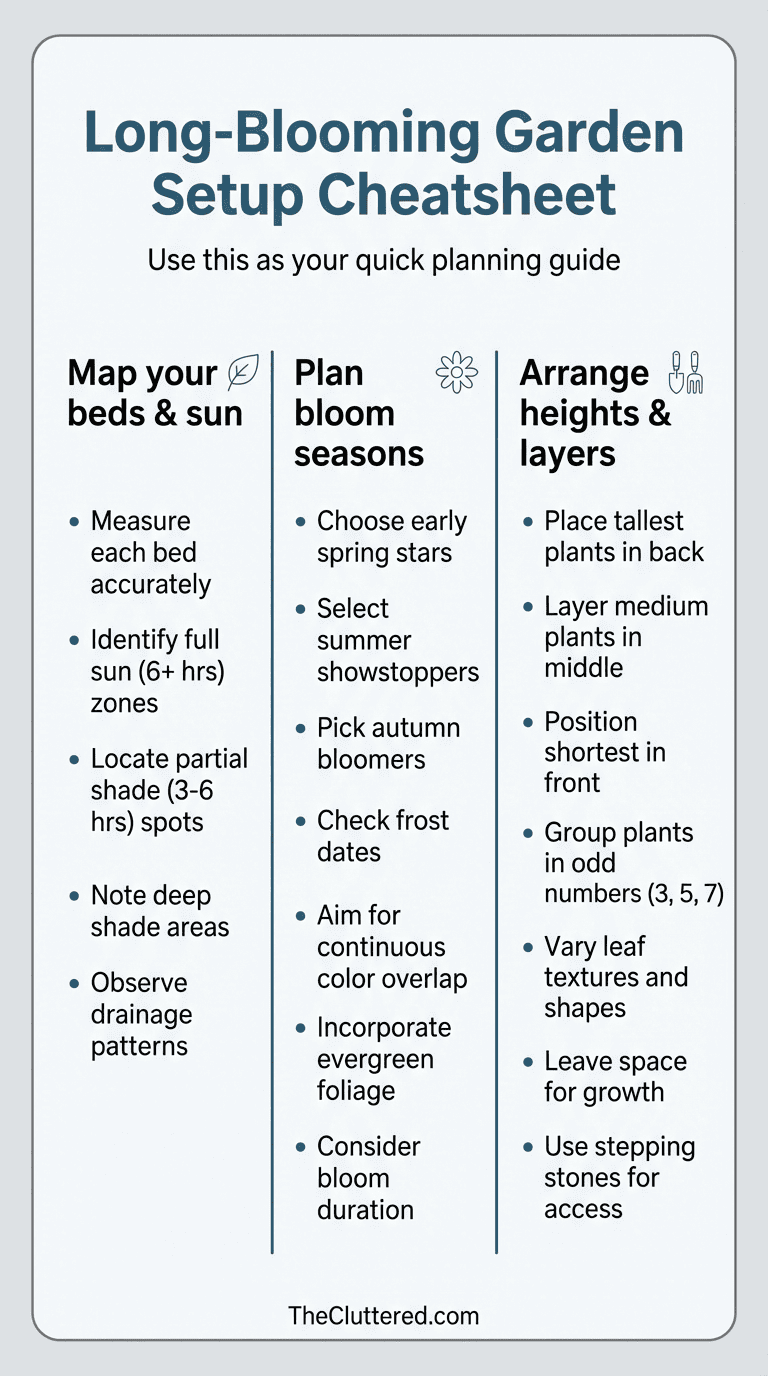
Step 1 – Map Your Space
- Measure each bed and note length, depth, and shape.
- Mark which areas get full sun, part sun, or shade.
- List key views (front door, driveway, favorite window).
- Note problem spots: dry corners, soggy patches, heavy wind.
- Sketch a simple outline of beds on plain or graph paper.
- Circle places where you want the strongest color pops.
- Highlight any existing trees, shrubs, or paths to keep.
- Decide how much time you realistically have for upkeep.
Step 2 – Plan Bloom Seasons
- Choose at least one hero plant for early spring color.
- Add 3–5 long-blooming perennials for summer.
- Include late-season workhorses for fall interest.
- Write bloom months next to each plant name.
- Check for gaps where no plant is blooming yet.
- Fill gaps with annuals or extra perennials as “bridge” plants.
- Repeat colors across the bed for a cohesive look.
- Balance flowers with foliage plants that look good all year.
Step 3 – Arrange Heights and Layers
- Place tallest shrubs and perennials at the back (or center of island beds).
- Use mid-height plants to form the main “ribbon” of color.
- Line the front edge with low growers or groundcovers.
- Group plants in odd numbers (3, 5, 7) for a natural look.
- Repeat key plant groups at least three times along the border.
- Leave room for plants to reach their mature width.
- Reserve a few small pockets for seasonal annuals.
- Walk around the bed and adjust so every angle has interest.
Step 4 – Planting & Care Basics
- Amend soil with compost in new or tired beds.
- Water deeply after planting and during the first season.
- Mulch to keep weeds down and moisture steady.
- Deadhead or lightly trim long-bloomers to encourage more flowers.
You don’t have to finish everything in one weekend. Treat this checklist like a flexible roadmap and tackle one section at a time.
Brought to you by TheCluttered.com